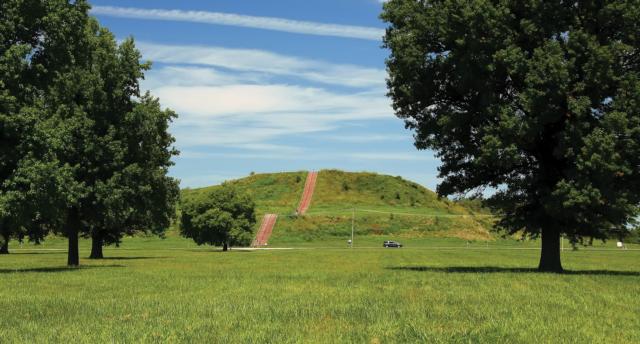
WASHINGTON – U.S. Senate Democratic Whip Dick Durbin (D-IL) and U.S. Senator Tammy Duckworth (D-IL) today reintroduced the Cahokia Mounds Mississippian Culture Study Act to require the National Park Service (NPS) to conduct a Special Resources Study (SRS) on Cahokia Mounds State Historic Site and its satellite sites.
Get The Latest News!
Don't miss our top stories and need-to-know news everyday in your inbox.
Durbin and Duckworth have long pushed for Cahokia Mounds to receive a National Historical Site designation from NPS, but in a congressional hearing in the 117th Congress, NPS indicated that a SRS must first be conducted on the site.
If Cahokia Mounds State Historic Site were to be elevated beyond its current designation as a National Historic Landmark, the site would be given additional protections for the ancient mounds in St. Clair and Madison Counties along with Sugarloaf Mound in St. Louis – the city’s only remaining mound.
“Cahokia Mounds is an important natural, archeological, and cultural landmark that represents the indigenous peoples and landscapes that once made up America’s first cities in the Western Hemisphere,” said Durbin. “With the Cahokia Mounds Mississippian Culture Study Act, we can take another step forward in obtaining a National Historic Site designation for Cahokia Mounds, recognizing it as the cultural asset that it is and preserving the area for generations to come.”
“The Cahokia Mounds State Historic Site is of extraordinary cultural and historical importance to our state and to this country,” Duckworth said. “After pushing for Cahokia Mounds to receive a National Historical Site designation from the National Park Service, I’m proud to introduce this bill alongside Senator Durbin to conduct a special resources study on the site and make progress toward properly recognizing this site at the federal level.”
The City of Cahokia was inhabited from 700 A.D. to 1400. At its peak, from 1050 to 1200, the city covered nearly six square miles, larger than London at that time, and between 10,000 and 20,000 people lived there. More than 120 mounds were built over time. The site is named for the Cahokia subtribe of the Illinois tribe, who moved into the area in the 1600s.