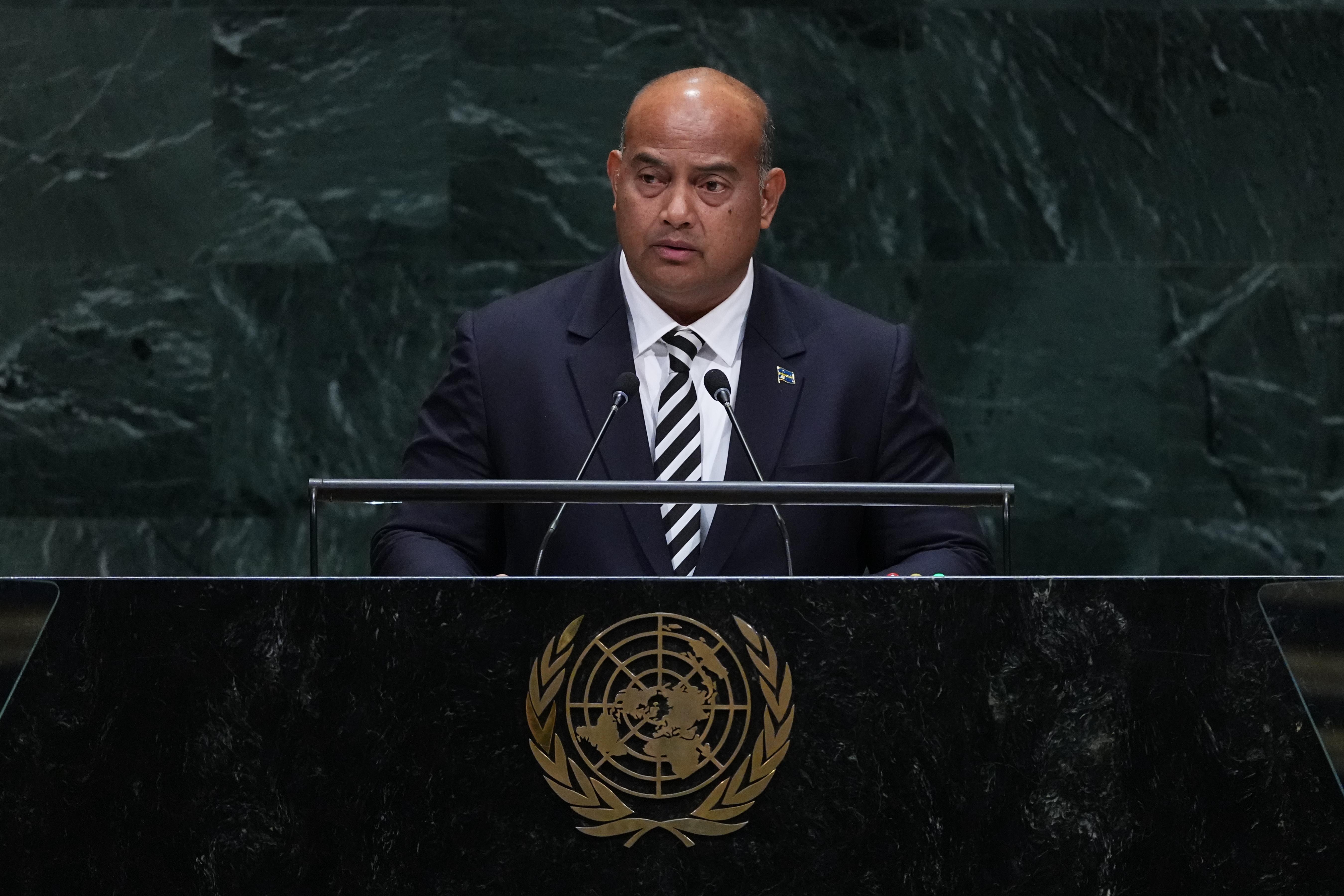
UNITED NATIONS (AP) — When Palau President Surangel Samuel Whipps Jr. recently took his children to his nation's Helen Island, two-thirds of it was gone. Rising seas caused by climate change had swallowed generational burial grounds, washing away a people's entire culture and identity.
“For us, it's devastating,” Whipps told The Associated Press on Friday, 40 years after his previous visit. “It doesn't mean we should give up.”
Get The Latest News!
Don't miss our top stories and need-to-know news everyday in your inbox.
In the global power game of the United Nations General Assembly, small island states, like Palau, are often on the sidelines, offering moral advice to the mighty who don't always listen. After all, their countries are tiny. Nearly 11 Marshall Islands, or about 30 Tuvalus, could fit inside New York City, where the United Nations is housed.
Now, some of the little land they do have is disappearing.
“Sometimes," Whipps said, “you get drowned out.”
He was referring to unequal power dynamics, but it also applies physically. When it comes to climate change, many of the world's island nations have banded together to be heard better. Their voices play the role of a conscience to a warming world, pleading to stop carbon pollution before it's too late.
In 2015, when the world was on the verge of signing the landmark Paris climate pact, it was small island nations that got the goal to limit global warming tightened from 2 degrees Celsius (3.6 degrees Fahrenheit) to 1.5 degrees (2.7 degrees Fahrenheit) since pre-industrial times. At the time, island nations said it was a matter of survival.
Now, scientists and the United Nations have conceded that the world is blowing past the 1.5 degrees mark — a temperature averaged over many years — in the next year or two. The best hope to keep this from happening permanently is for the world to reduce coal, oil and gas use to zero in coming decades, so that sometime this century, temperatures will go back down below the 1.5 degrees threshold, they said.
“Each fraction of a degree of warming increases the risk of irreversible sea level rise,” said Anna Rasmussen, chief negotiator for the Alliance of Small Island States. “We absolutely cannot surrender our pursuits of 1.5.”
What does breaching 1.5 degrees mean? “Death,” said Joyelle Clarke, environment minister for the Caribbean island nation of Saint Kitts and Nevis, standing outside the U.N. Security Council.
This is unfair because small islands didn't cause climate change, Marshall Islands President Hilda Heine said during her speech to the General Assembly on Friday; big industrial nations did.
“We’ve seen schools destroyed by rising seas, salt water poisoning our wells and disease outbreaks linked to environmental change,” Heine told her fellow leaders. “This injustice must be addressed. Our communities deserve restitution.”
Earlier this week, the U.N. adopted a resolution that called for small island states to keep sovereignty and marine rights no matter what rising seas do. One of the major messages nation after nation gave: Despite rising seas, they are not going anywhere.
“The survival of our nations cannot be negotiated,” said Adão Soares Barbosa, special envoy on climate affairs for the Southeast Asian island nation of East Timor and chair of the Least Developed Countries Group on Climate Change. “We cannot absorb another year of promises without delivery.”
Tuvalu Prime Minister Feleti Teo said his country may only have 26 square kilometers (10 square miles) of land, but it's responsible for 750,000 square kilometers (nearly 290,000 square miles) of oceans.
“Tuvalu's nationhood is not negotiable,” echoed Teo, who called climate change the “single greatest existential threat” to his country. “Our people should never be forced to choose between their homeland and their future.”
Marshall Island Foreign Minister Kalani Kaneko said his people "have no other choice but to finally stay home, raise our own people, speak our own language and protect our own identity. We're not giving up.”
Clarke, from Saint Kitts and Nevis, said the rest of the world doesn't feel or see what island nations are going through.
“For many folks that look at the islands in the Caribbean and the Pacific, they see paradise. They see the two-week getaway — sun, sand, sea, adventure,” Clarke said. “The very beaches that you travel thousands of miles for and save up for your holiday, those beaches are disappearing.”
Clarke, who also works with her nation's youth, said “We’re seeing a generation that’s losing hope, that’s constantly facing despair, that are questioning, ‘Why should we care? Why should we do anything, when you all don’t care enough, and the world doesn’t care enough, about our future?'”
This issue hits home for Whipps from Palau, who has adult children but no grandchildren.
“The sad part is, some of the kids, you talk to them, and they don’t want to have kids, because they think, 'Why do you want to bring them to a world that’s faced with these problems?” he said. “That’s also something that we need to take responsibility for.”
___
Associated Press writer Jennifer McDermott contributed to this report from New York.
___
The Associated Press’ climate and environmental coverage receives financial support from multiple private foundations. The AP is solely responsible for all content. Find AP’s standards for working with philanthropies, a list of supporters and funded coverage areas at AP.org.