

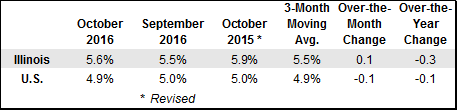
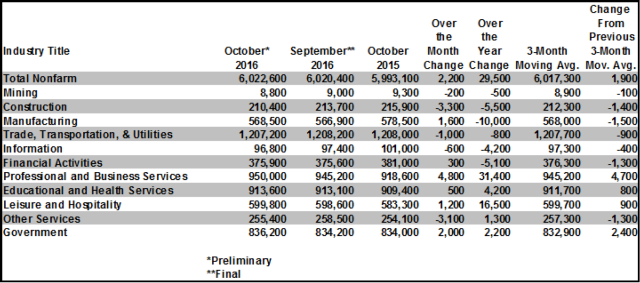
CHICAGO–The Illinois Department of Employment Security (IDES) announced today that the unemployment rate in October edged up to 5.6 percent and nonfarm payrolls increased by +2,200 jobs over the month, based on preliminary data released by the U.S. Bureau of Labor Statistics (BLS) and IDES. September job growth was revised up to show an increase of +11,500 rather than the preliminary figures of +7,400 jobs. Nonetheless, job growth is still below the national average, with Illinois -32,500 jobs short of its peak employment level reached in September 2000.
Get The Latest News!
Don't miss our top stories and need-to-know news everyday in your inbox.
Construction payrolls decreased by -3,300 jobs in October which added to the three-month momentum against manufacturing and construction jobs as well as financial activities and trade, transportation and utilities. Three-month momentum favors professional and business services as well as government employment and to a lesser extent leisure and hospitality and education and health services.
“Illinois continues to recover at a slower rate than the rest of the nation as witnessed by the meager payroll gains in October,” said IDES Director Jeff Mays. “The recovery has been uneven among the various sectors as Illinois still lags in manufacturing, construction, and financial activities as well as trade, transportation and utilities.”
“High costs and competition from surrounding states continue to drain manufacturing jobs from Illinois. We saw several manufacturers move across the border to Wisconsin in October,” Illinois Department of Commerce & Economic Opportunity Acting Director Sean McCarthy said. “1,600 new manufacturing jobs is a start, but it is a drop in the bucket compared to the 10,000 manufacturing jobs Illinois has lost over the last twelve months – an average loss of nearly 200 jobs per week. We can build on this month’s growth by making Illinois more competitive and affordable for manufacturers.”
In October, the three industry sectors with the largest gains in employment were: Professional and Business Services (+4,800); Government (+2,000); and Manufacturing (+1,600). The three industry sectors with the largest declines in employment were: Construction (-3,300); Other Services (-3,100); and Trade, Transportation and Utilities (-1,000).
Over the year, nonfarm payroll employment increased by +29,500 jobs with the largest gains in two industry sectors: Professional and Business Services (+31,400); and Leisure and Hospitality (+16,500). Industry sectors with the largest over-the-year declines in October include: Manufacturing (-10,000), Construction (-5,500) and Financial Activities (-5,100). The +0.5 percent over-the-year gain in Illinois is less than the +1.7 percent gain posted by the nation in October.
The state’s unemployment rate is higher than the national unemployment rate reported for October 2016, which edged down to 4.9 percent. The Illinois unemployment rate is down -0.3 percentage points from a year ago when it was 5.9 percent.
The number of unemployed workers increased +1.7 percent from the prior month to 366,600, down -5.3 percent over the same month for the prior year. The labor force was nearly unchanged over-the-month and grew by +0.6 percent in October over the prior year. The unemployment rate identifies those individuals who are out of work and are seeking employment. An individual who exhausts or is ineligible for benefits is still reflected in the unemployment rate if they actively seek work.
To help connect jobseekers to employers who are hiring, IDES’ maintains the state’s largest job search engine IllinoisJoblink.com (IJL). IJL recently showed that 61,857 resumes were posted and 172,369 help wanted ads were available.
-
Monthly 2011 - 2015 labor force data for Illinois, and all other states, have been revised as required by the U.S. Bureau of Labor Statistics (BLS). The monthly historical revisions to state labor force estimates reflect new national benchmark controls, state working-age population controls, seasonal factors, as well as updated total nonfarm jobs and unemployment benefits claims inputs. Illinois labor force data were also smoothed to eliminate large monthly changes as a result of volatility in the monthly Census Population Survey (CPS) and national benchmarking. For these reasons, comments and tables citing unemployment rates in previous state news releases/materials might no longer be valid.
-
Monthly seasonally adjusted unemployment rates for Illinois and the Chicago-Naperville-Arlington Heights Metropolitan Division are available here: Illinois & Chicago Metropolitan Area Unemployment Rates
-
Monthly 1994 – 2014 unadjusted and seasonally adjusted nonfarm payroll data for Illinois have been revised. To control for potential survey error, the estimates are benchmarked annually to universal counts derived primarily from unemployment insurance tax reports.
-
Not seasonally adjusted jobs data with industry detail are available at Not Seasonally Adjusted Jobs. “Other Services” include activities in three broad categories: Personal and laundry; repair and maintenance; and religious, grant making, civic and professional organizations. Seasonally adjusted employment data for subsectors within industries are not available.
About IDES
IDES encourages employment by connecting employers to jobseekers, provides unemployment insurance benefits to eligible individuals, produces labor market data and protects taxpayers from unemployment insurance fraud. Visit the Department’s website atwww.ides.illinois.gov for more information. You can also follow IDES on Twitter andFacebook.


