Chicago, Ill.— Nine outstanding preservation efforts from across the state will be honored next month by Landmarks Illinois, a statewide group that advocates for the protection of historic properties.
This year’s award winners tell a unique story about Illinois’ history – a story that stretches from an immigrant religious colony in the western Illinois prairie to a historic brewery on the edge of northern Illinois’ Rock River. An iconic mansion built in the 1880s is juxtaposed with a converted public housing project opened in the 1980s, along with a modest one-room dome home in southern Illinois and a 241-room luxury hotel on Michigan Avenue. This year’s winning projects and people represent the state’s diversity, but they are all linked by a common goal: to honor Illinois’ heritage and preserve its historic treasures.
Get The Latest News!
Don't miss our top stories and need-to-know news everyday in your inbox.
“This has been an extraordinary year for preservation in Illinois,” said Bonnie McDonald, president of Landmarks Illinois. “Increasingly, building owners and developers are recognizing that the preservation and reuse of notable architecture not only enhances the beauty of the state, but also can significantly improve the vibrancy and livability of our neighborhoods, fostering civic pride, community involvement, and additional reinvestment.”
Each winner will receive a Richard H. Driehaus Foundation Preservation Award—which includes $500 and a distinctive trophy – at a special ceremony on October 17 at Venue One in Chicago. The award-winners are:
Bishop Hill Heritage Association, Bishop Hill – Stewardship
The Bishop Hill Heritage Association (BHHA) was founded in 1962 to preserve and promote the history of the Bishop Hill Colony, a utopian commune settled by Swedish immigrants in 1846. BHHA has been a faithful steward of four buildings in the historic district. Over the last five years, the association has undertaken extensive renovations of most of these buildings, including the 1853 Colony Store, the 1854 Steeple Building, and the 1855 Dairy Building. In total, BHHA has raised and invested more than $700,000 in rehabilitating these three historic buildings.
Chicago Athletic Association Hotel, Chicago – Rehabilitation
Development firm AJ Capital Partners meticulously renovated the Venetian Gothic Chicago Athletic Association building designed by Henry Ives Cobb in 1893. The project included restoring the building’s ornamental plaster and Carrera marble flooring, constructing a breath-taking rooftop deck, and updating the building’s mechanical, electrical, plumbing and A/V systems. Ultimately, the project team transformed the iconic building, which formerly housed a private athletic club for Chicago’s elites, into a 241-room boutique hotel with a stylish restaurant, bar, game room, and rooftop lounge. Prior to being purchased and renovated by AJ Capital, the Athletic Association building had twice appeared on Landmarks Illinois’s “Most Endangered Historic Places” list. This project not only restored a beautiful, iconic building on Chicago’s most traveled street but also opened the spectacular space to the general public for the first time.
Dorchester Art + Housing Collaborative, Chicago – Project of the Year
Led by Theaster Gates Jr.’s Rebuild Foundation, architect Catherine Baker of Landon Bone Baker and Brinshore Development’s Peter Levani, this remarkable initiative reused the townhouses of an abandoned public housing development in Chicago’s Greater Grand Crossing neighborhood, converting the blighted block into a cultural hub featuring an active and popular Art Center and 32 mixed-income rental units, including spaces reserved for working artists. Not only did this project transmute a neighborhood worthy of preservation, it has transformed a neglected neighborhood into a lively community replete with safe and affordable housing, an incubator for the arts and a community space for Grand Crossing residents.
Fuller Dome Home, Carbondale – Restoration
Built in 1960, the “Bucky” Dome Home is named for its designer and original owner R. Buckminster Fuller. A theorist, architect, inventor, and longtime Southern Illinois University professor, Fuller patented the design for the geodesic dome in 1954. He envisioned the dome as a model for durable, affordable, accessible, and efficient housing. The prefabricated dome home was assembled on a concrete foundation over a period of seven hours on April 19, 1960. Bucky and his wife, Anne Hewlett Fuller, resided in the home until 1972, distinguishing this national and local landmark as the only geodesic dome Bucky lived in full-time.
After falling into disrepair, the Bucky Dome Home was donated to the RBF Dome NFP in 2002. With a National Park Service Save America’s Treasures Grant, the non-profit organization rehabilitated the dome’s exterior. The rehabilitation included reroofing the Dome and restoring the structure’s original geometry. According to the RBF Dome NFP, the exterior restoration of the Fuller Dome Home represents an important first step in establishing the R. Buckminster Fuller Museum. RBF Dome NFP envisions the museum as a hub and intellectual incubator space for scholars, architects, and designers in southern Illinois.
Glessner House Museum, Chicago – President’s Award for Stewardship
Saving the Glessner House from a ruinous state in the 1960s is only the beginning of this museum’s story. For fifty years, the Glessner House Museum has cared for and interpreted the legacy of this 1887 Henry Hobson Richardson masterpiece on Chicago’s famed Prairie Avenue. Glessner House Museum has been a model steward of the property, initiating a number of restoration projects that continue to move the home closer to its original grandeur. Most recently, GHM restored the mansion’s parlor, guest bedroom, and guest bathroom, projects that involved meticulously reproducing historic draperies as well as intricate, hand-painted canvas wall coverings.
The museum will soon install a new geothermal system, allowing the staff to control heat and humidity levels for the first time and bringing 21st century technology to bear on this 19th century home. Through its ongoing stewardship of the Gilded Age mansion, the Glessner House Museum has established itself as a national model for preservation groups and historic house museums.
Downtown Jacksonville Turnaround, Jacksonville – Advocacy
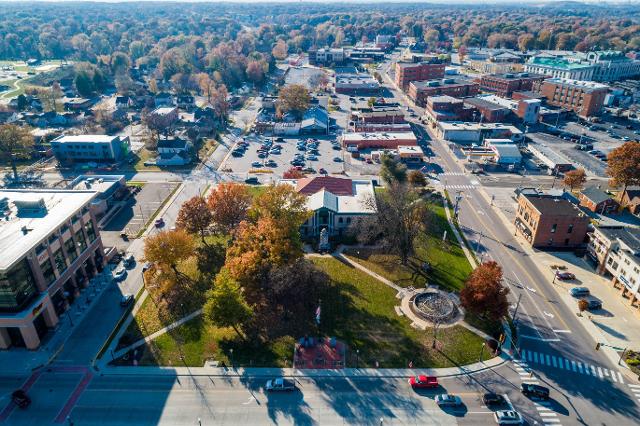
Hoping to reverse a decline that began in the 1970s, Jacksonville’s citizens joined together to found the Jacksonville Main Street foundation in 1999. Jacksonville Main Street (JMS) has been dedicated to revitalizing and restoring the historical feel of the city’s downtown. Specifically, JMS has supported the removal of non-historic buildings and storefront façades, the improvement of infrastructure and landscaping, and the installation of speakers, lighting, and other amenities in the town square. The Downtown Jacksonville Turnaround project culminated in May 2015 with the completion of a six-year, $14 million project that increased traffic flow around the town square and returned parking to the front of retail shops.
The Downtown Jacksonville Turnaround project has had a tremendous impact on the local economy. After more than fifteen years of effort, Jacksonville Main Street has inspired sixty-five property owners to undertake their own rehabilitation projects, spurring more than $35 million in public and private investments. Forty businesses have either expanded their existing operations along or relocated their businesses to the town square, driving vacancy rates down from a high of 27% to less than 5%. More than 170 jobs have been created since the project began. Thousands of people again flock to Jacksonville’s town square for its retail shops and special events.
Laurent House Foundation, Rockford – Advocacy + ADA 25 Award
In 1949, Frank Lloyd Wright designed the Laurent House for Kenneth Laurent, a paraplegic World War II veteran, and his wife Phyllis. Wright strove to accommodate his client’s disability and personal dignity without sacrificing design. The resulting house is an ingenious marriage of accessibility with Wright’s Usonian principles. Equally remarkable, Frank Lloyd Wright’s thoughtful and accessible design predates the Americans with Disabilities Act by more than three decades. Kenneth and Phyllis remained in the home until 2011 when they placed the property and its Wright-designed furnishings up for auction.
Faced with the possibility of losing an architectural treasure that Frank Lloyd Wright proudly called his “little gem,” a group of concerned Rockford citizens rallied together to form the Laurent House Foundation. LHF moved to purchase, restore, and reopen the residence as a historic house museum. In a single month, the group raised more than $1 million from city, state, and county governments as well as a number of corporations, organizations, and private citizens. LHF immediately began restoring the Laurent House, installing a new roof, repairing the home’s structure, restoring the concrete floors, and refinishing its interior woodwork. The foundation also updated the home’s mechanical and security systems without modifying its unique aesthetic. The Laurent House Museum opened in 2014.
Mike Jackson, Springfield – Joe Antunovich Award for Leadership
Over his forty-year career, Mike Jackson has established himself as one of the leading advocates for historic preservation in the state. From 1983 to 2013, Jackson served in the Illinois Historic Preservation Agency, most notably as its chief architect and later as the manager of Preservation Services. During his time at IHPA, Jackson provided guidance for the rehabilitation and restoration of some of the state’s most recognizable buildings, including the Tribune Tower, Frank Lloyd Wright’s Dana-Thomas House, the Rookery, and the Reliance Building.
Outside of his work with IHPA, Jackson has spearheaded a number of national preservation initiatives, including: Recent Past, which encourages the preservation of mid- to late-twentieth century buildings; Green Preservation, which trumpets historic preservation as a form of sustainable building; and Upstairs Downtown, which provides a roadmap for reviving previously unused spaces on the upper floors of historic buildings. Jackson has taught at both Columbia University and the University of Illinois at Urbana-Champaign, educating and mentoring a new generation of preservation architects.
Prairie Street Brewhouse, Rockford – Rehabilitation
Constructed on the edge of the Rock River between 1857 and 1922, the Prairie Street Brewhouse originally served as the home of the Rockford Brewing Company. Loyd and Diane Koch purchased the imposing building in 2000. After a decade of planning, the Kochs began an extensive rehabilitation project to return the building to its roots as a brewery while transforming it into one of Rockford’s premier entertainment and social venues. The Prairie Street Brewhouse now serves as a mixed-used space that houses a brewery, banquet hall, restaurant, office space, and residential lofts.
The Prairie Street Brewhouse draws hundreds of people to downtown Rockford and the riverfront daily, helping to revitalize the city’s downtown area. As one of the first projects to utilize the Illinois State Historic Tax Credit, the Prairie Street Brewhouse also illustrates the importance of the pilot program in stimulating private investment in historic preservation.
About Landmarks Illinois
Landmarks Illinois helps people save places. Formed in 1971, Landmarks Illinois serves as the state’s leading voice for historic preservation by promoting the reuse of buildings as a strategy for economic development and sustaining healthy communities, while expanding the public’s understanding and stewardship of the built environment. Landmarks Illinois is the only not-for-profit organization inspiring local action statewide to catalyze incremental and transformational community change through historic preservation.
About the Awards
Since 1994 Landmarks Illinois has been aided by a generous grant from the Richard H. Driehaus Foundation to honor those whose work demonstrates a commitment to excellence in historic preservation.
This year’s awards jury was:
- Amber Bailey, Loyola University Masters Candidate
- Lee Brown, Teska Associates, Inc.
- Jake Goldberg, Goldberg General Contracting
- Tiffany Hamel Johnson, Chicago Urban League
- Bonnie McDonald, Landmarks Illinois
- Chelsea Medek, Klein and Hoffman
- Alice Novak, University of Illinois at Urbana–Champaign
The awards ceremony, which includes cocktails and appetizers, will be held Saturday, Oct. 17 at Venue One, 1034 W. Randolph, and is open to the public. The program begins with a panel discussion at 3 p.m. followed by the awards presentation at 4:30 p.m. and a cocktail reception at 6 p.m. Tickets are available at $40 for members and $50 for non-members. To make a reservation visit our website at landmarks.org/awards.htm or contact Landmarks Illinois at 312-922-1742.
Landmarks Illinois serves as the state’s leading voice for historic preservation by promoting the reuse of buildings as a strategy for economic development and sustaining healthy communities, while expanding the public’s understanding and stewardship of the built environment. Since its founding in 1971, the 2,500-member statewide organization has saved countless architectural and historic treasures throughout Illinois. For more information, visit www.Landmarks.org.