 This Day in History: October 31, 2026
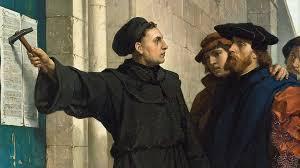
On October 31, 1517, Martin Luther challenged the sale of indulgences, a practice linked to the Catholic Church’s teaching about punishment for sin. His Ninety-five Theses helped set the Protestant Reformation in motion, changing Christianity and reshaping European politics, education, and culture. Luther initially sought debate and reform, not the creation of a separate church. Yet the dispute widened into a lasting division within Western Christianity. Its effects remain visible in religious traditions around the world and in the history of literacy, government, and freedom of belief.
Major Historical Events
1517: Luther’s challenge and the Protestant Reformation
The German theologian sent his theses to Archbishop Albrecht of Mainz on this date. According to a long-standing tradition, he also posted them on the door of the Castle Church in Wittenberg, although historians debate the evidence for that particular act.
Get The Latest News!
Don't miss our top stories and need-to-know news everyday in your inbox.
Indulgences were associated with the remission of temporal punishment for sins already forgiven. Luther objected especially to claims made in their promotion and to the suggestion that money could secure spiritual benefits. Printing helped his arguments circulate far beyond a university audience. The resulting conflict drew in church authorities, rulers, and ordinary believers, eventually producing new denominations, religious warfare, and reforms within Catholicism itself.
1864: Nevada joins the United States
More than three centuries later, Nevada became the 36th U.S. state during the American Civil War. Its admission came shortly before the presidential election and added support for Abraham Lincoln’s administration.
Mining had accelerated settlement and economic development in the region, though its population remained small. Statehood extended federal political institutions across another part of the American West. That expansion also formed part of a broader transformation of Indigenous homelands through settlement, resource extraction, and government control.
1917: The capture of Beersheba
During World War I, British Empire forces captured Beersheba from Ottoman defenders in southern Palestine. Australian mounted troops carried out a notable late-afternoon charge, helping secure the town and its important water supplies.
The victory opened a route around Ottoman defenses near Gaza and supported the British advance toward Jerusalem. Although the mounted charge became especially prominent in Australian military memory, the battle involved infantry, artillery, and mounted units from several parts of the British Empire. It belonged to a wider campaign whose outcome helped end centuries of Ottoman rule in the region.
1940: The recognized end of the Battle of Britain
October 31 marks the official end of the Battle of Britain in British historical commemoration. Beginning in July, German air operations had sought to overcome Britain’s air defenses and create conditions favorable to invasion.
Royal Air Force personnel, including aircrew from several countries, resisted those attacks with help from radar, ground observers, maintenance crews, and an organized command system. Germany failed to establish air superiority. The date is a historical boundary rather than the moment air attacks stopped: bombing continued during the Blitz and afterward.
1956: Britain and France begin bombing Egypt
Following Israel’s invasion of Egypt’s Sinai Peninsula on October 29, British and French aircraft began attacking Egyptian targets on October 31. The operation followed a secret agreement among the three countries and came after Egyptian President Gamal Abdel Nasser nationalized the Suez Canal Company.
Britain and France presented their intervention as a way to separate the combatants and protect the canal. International pressure, including opposition from the United States and the Soviet Union, helped force a withdrawal. The crisis strengthened Nasser’s regional standing and exposed limits on Britain’s and France’s ability to act independently as imperial powers.
1984: Indira Gandhi is assassinated
Indian Prime Minister Indira Gandhi was killed by two Sikh members of her security detail in New Delhi. The assassination followed months of tension, including Operation Blue Star, the army operation she had ordered against armed militants inside the Golden Temple complex in Amritsar.
Her death was followed by widespread anti-Sikh violence, especially in Delhi, in which thousands were killed. Gandhi’s son Rajiv became prime minister. The assassination and its aftermath left enduring questions about communal relations, political leadership, and accountability for mass violence.
1992: The Vatican addresses the Galileo case
At a meeting of the Pontifical Academy of Sciences, Pope John Paul II acknowledged errors in the Church’s handling of Galileo Galilei’s case. Galileo had been condemned in 1633 after defending the movement of Earth around the Sun.
The address followed a lengthy review and was not a new scientific ruling or a formal reversal of the original judgment. Its importance lay in recognizing failures in how religious authorities had treated scientific inquiry and interpreted scripture.
2000: The United Nations adopts Resolution 1325
The UN Security Council unanimously adopted Resolution 1325 on women, peace, and security. It called for greater participation by women in conflict prevention, peace negotiations, and postwar recovery, alongside stronger protection for women and girls during war.
The resolution gave international recognition to work long pursued by women’s organizations. It also established a framework for national policies and peacekeeping practices, though implementation has remained uneven.
2011: A global population milestone
The United Nations designated October 31 as the symbolic day the world’s population reached seven billion. No exact birth could establish the total, because population figures depend on estimates and incomplete records.
The milestone reflected longer lives and improved survival, while drawing attention to differences in access to health care, education, food, and housing. It also encouraged discussion about how population change interacts with resource use and development.
Notable Births
Poet John Keats, born in 1795, created some of the best-known works of English Romantic literature during a short life. His odes explored beauty, mortality, imagination, and the passing of time.
German chemist Adolf von Baeyer was born in 1835. His research on organic compounds, particularly dyes and indigo, advanced both chemical understanding and industrial production. He received the Nobel Prize in Chemistry in 1905.
Born in 1875, Vallabhbhai Patel became a leader of India’s independence movement and the country’s first deputy prime minister. He played a central role in integrating hundreds of princely states into independent India.
Architect Zaha Hadid, born in Baghdad in 1950, became known for buildings with sweeping lines and complex forms. In 2004, she became the first woman to receive the Pritzker Architecture Prize.
Notable Deaths
Austrian artist Egon Schiele died in 1918 during the influenza pandemic, aged 28. His intense portraits and expressive drawings became important works of early twentieth-century modern art.
Escape artist and magician Harry Houdini died in 1926 from complications of appendicitis. Alongside his stage career, he investigated and exposed fraudulent claims of communication with the dead.
The death of Indira Gandhi in 1984 ended the career of one of India’s most influential leaders. Her legacy includes major political and economic changes, the 1971 war with Pakistan, and the controversial Emergency of 1975–1977.
Punjabi writer Amrita Pritam died in 2005. Her poetry and fiction addressed love, women’s lives, and the suffering caused by the 1947 Partition of British India, giving lasting literary expression to personal and collective loss.
Across these anniversaries, October 31 brings together religious debate, military conflict, scientific inquiry, artistic creation, and efforts to widen participation in public life. The people born and remembered on this date show how individual work intersects with larger changes. Together, these moments reveal a human story shaped both by sudden turning points and by ideas whose influence unfolds over generations.