This Day in History: October 14, 2026
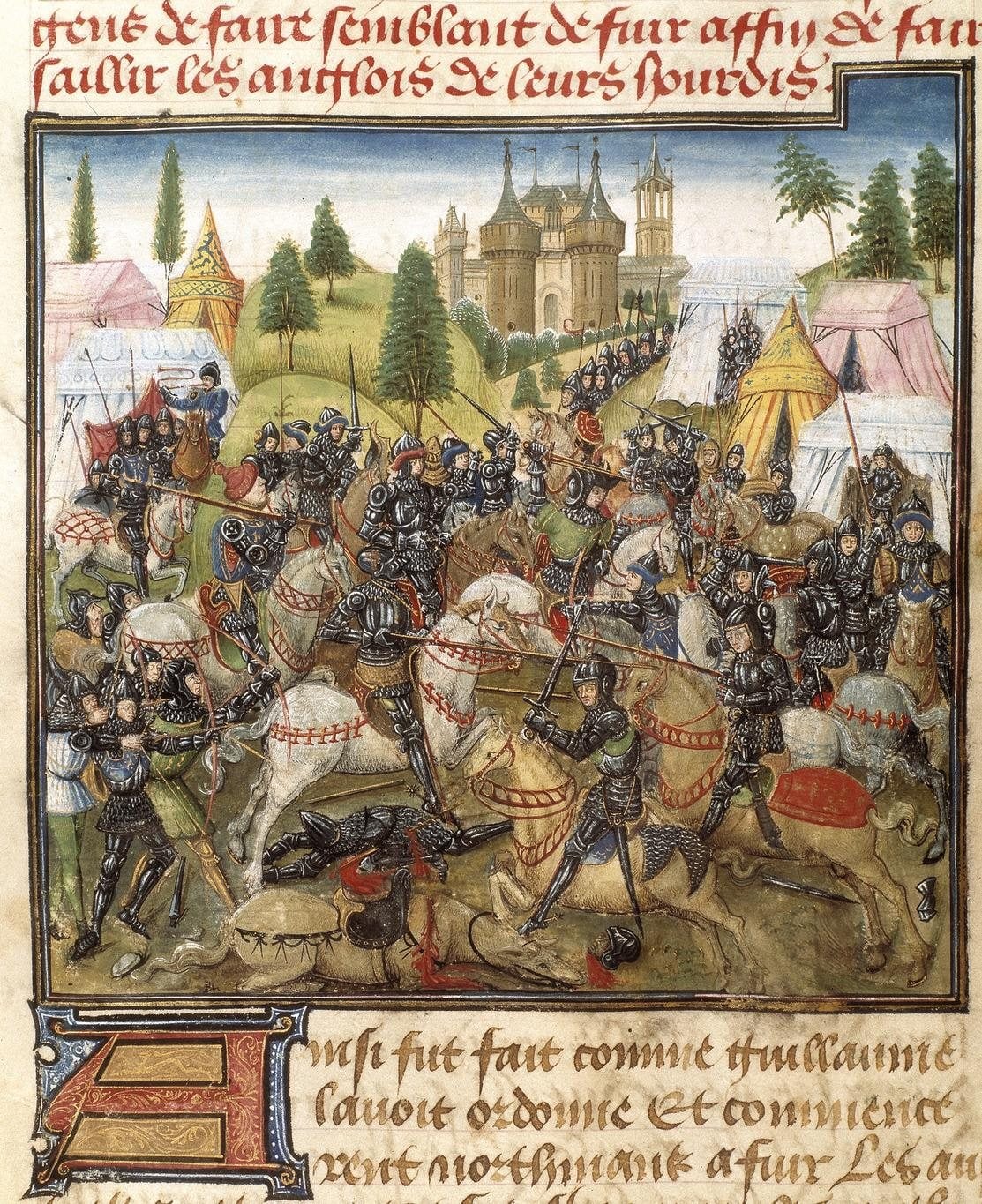
On October 14, 1066, William, Duke of Normandy, defeated King Harold II of England at the Battle of Hastings. Harold died in the fighting, and William’s victory opened the way for the Norman conquest of England. The battle grew out of a disputed royal succession, but its consequences reached far beyond the question of who would wear the crown. Norman rule changed land ownership, government, architecture, and the language spoken in England. Those changes helped shape institutions and an English vocabulary that remain part of daily life centuries later.
Looking back from October 14, 2026, this date also marks scientific breakthroughs, struggles over political power, movements for social change, and achievements in literature and sport.
Get The Latest News!
Don't miss our top stories and need-to-know news everyday in your inbox.
Major Historical Events
1066: The Battle of Hastings reshapes England
England’s succession crisis began when Edward the Confessor died without a child to inherit his throne. Harold Godwinson became king, but William of Normandy challenged his claim. After defeating a Norwegian invasion in northern England, Harold moved south to confront William’s forces near Hastings.
The battle lasted much of the day. William’s army eventually broke the English defenses, although the exact circumstances of Harold’s death remain uncertain. William was crowned on Christmas Day. Resistance continued afterward, but the conquest gradually replaced much of England’s ruling elite and strengthened its connections with continental Europe.
1806: Napoleon defeats Prussia at Jena and Auerstedt
Two battles fought on October 14 dealt a major blow to Prussia. Napoleon defeated one Prussian force at Jena, while Marshal Louis-Nicolas Davout overcame another at Auerstedt despite facing a larger army.
The defeats exposed weaknesses in Prussian military organization and helped bring much of the kingdom under French occupation. Prussia subsequently pursued reforms in its army, administration, and education. These changes contributed to its recovery and later role in European affairs.
1882: The University of the Punjab is established
The University of the Punjab was established in Lahore, then part of British India and now in Pakistan. It became an important center of higher education in the region, supporting instruction and examinations across a growing network of affiliated colleges.
Its development reflected both colonial educational policy and regional demand for advanced learning. Through later political changes, including the partition of British India in 1947, the university continued to influence scholarship and professional life.
1926: Winnie-the-Pooh reaches readers
A. A. Milne’s Winnie-the-Pooh, illustrated by E. H. Shepard, was published on October 14. Inspired partly by Milne’s son, Christopher Robin, and his toys, the stories introduced readers to a bear and his companions in the Hundred Acre Wood.
The book’s humor and attention to friendship helped it reach audiences well beyond Britain. Translations and adaptations later made its characters familiar around the world, although the original stories have a quieter style than many subsequent screen versions.
1943: Prisoners revolt at Sobibor
Jewish prisoners at the Sobibor killing center in German-occupied Poland launched an organized revolt against their Nazi captors. Led principally by Leon Feldhendler and Alexander Pechersky, the resistance group killed several camp personnel before hundreds of prisoners attempted to escape.
Many escapees were killed during the breakout or recaptured afterward; a smaller number survived the war. The uprising disrupted the camp’s operations, and the Nazis subsequently dismantled it. Sobibor remains an important example of organized Jewish resistance during the Holocaust.
1947: Chuck Yeager breaks the sound barrier
U.S. Air Force pilot Chuck Yeager flew the rocket-powered Bell X-1 faster than the speed of sound in controlled, level flight over California. The aircraft was released from a bomber before beginning its powered ascent.
Engineers had faced serious problems with aircraft stability near the speed of sound. The flight demonstrated that those problems could be overcome through design and testing, advancing knowledge that supported later supersonic aircraft.
1956: B. R. Ambedkar converts to Buddhism
In Nagpur, India, jurist and social reformer B. R. Ambedkar formally adopted Buddhism alongside a vast gathering of followers, many of them Dalits. Ambedkar had spent decades challenging caste discrimination and had played a leading role in drafting India’s Constitution.
His conversion followed his rejection of caste inequality within Hindu society. It helped establish a modern Buddhist movement in India and gave many participants a new framework for religious identity and social dignity.
1964: A Nobel announcement and a Soviet leadership change
Martin Luther King Jr. was announced as the recipient of the Nobel Peace Prize for his nonviolent campaign against racial discrimination in the United States. At 35, he was then the youngest Peace Prize recipient. The award brought international recognition to a movement seeking equal rights through demonstrations, legal challenges, and legislation.
That same day, Soviet leader Nikita Khrushchev was removed from power by fellow Communist Party leaders. Dissatisfaction with his management, policy changes, and foreign-policy setbacks contributed to his dismissal. Leonid Brezhnev became party leader, while Alexei Kosygin became head of government.
1968: Jim Hines runs an Olympic landmark
At the Mexico City Olympics, American sprinter Jim Hines won the men’s 100 meters in an electronically timed 9.95 seconds. It became the first fully automatic sub-10-second performance recognized as a world record.
Mexico City’s high altitude reduced air resistance, benefiting short sprint events. Hines’s race nevertheless marked a significant athletic achievement and helped establish electronic timing as the standard for comparing elite performances.
1981: Hosni Mubarak becomes Egypt’s president
Hosni Mubarak assumed Egypt’s presidency following the assassination of Anwar Sadat on October 6. A former air force commander, Mubarak had served as vice president since 1975.
His accession preserved continuity in government during an immediate crisis. Over nearly three decades, his administration maintained Egypt’s peace treaty with Israel and close relations with the United States, while governing under emergency powers and restrictions on political opposition.
2012: Felix Baumgartner makes a stratospheric jump
Austrian skydiver Felix Baumgartner jumped from a balloon-carried capsule approximately 39 kilometers above Earth. During his descent, he exceeded the speed of sound without the protection of an aircraft.
The project required specialized pressure equipment and extensive safety planning. Alongside its record-setting achievement, it gathered information relevant to high-altitude survival and emergency escape systems.
Notable Births
William Penn, born in 1644, founded Pennsylvania as an English colony. His Quaker beliefs informed policies supporting religious toleration, making the colony an important experiment in accommodating different faiths.
Dwight D. Eisenhower, born in 1890, commanded Allied forces in Western Europe during World War II and later became the 34th U.S. president. His career connected wartime coalition leadership with the early Cold War.
Hannah Arendt, born in 1906, examined totalitarianism, political responsibility, and the conditions of public life. Having fled Nazi Germany, she produced works that remain influential in political thought.
Roger Moore, born in 1927, became internationally known through television’s The Saint and seven James Bond films. He also served for many years as a UNICEF goodwill ambassador.
Notable Deaths
Erwin Rommel died in 1944. Known for commanding German forces in North Africa, he was implicated in opposition to Adolf Hitler and forced to take poison under threat of prosecution and reprisals against his family.
Leonard Bernstein died in 1990. The American conductor, composer, and educator helped bring classical music to broad audiences. His works included the music for West Side Story.
Julius Nyerere died in 1999. Tanzania’s founding president promoted national unity, African independence, and the use of Swahili. His socialist development policies had lasting influence but also faced serious economic difficulties.
Across these anniversaries, history appears at many scales: a battlefield, a university, a prison uprising, a children’s book, and a flight into unfamiliar conditions. The people born and remembered on October 14 likewise shaped institutions, ideas, and culture in different ways. Together, their stories show how individual choices and wider circumstances combine to change the human experience.