
ALTON – Summer means snakes in some of the wilder regions of the Riverbend.
Get The Latest News!
Don't miss our top stories and need-to-know news everyday in your inbox.
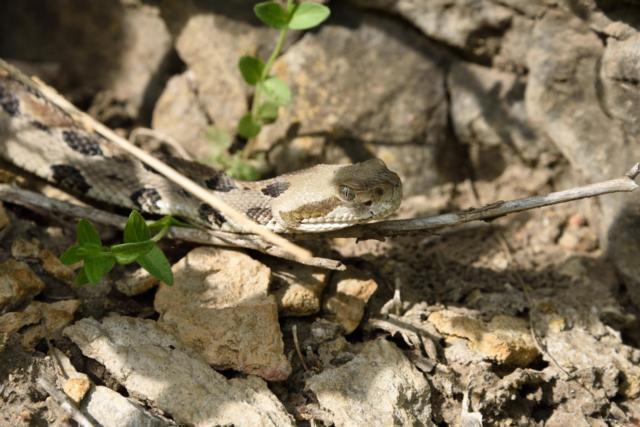
While many people may fear these creatures, associated with all sorts of negative things throughout the history of human mythology, the snakes around the Riverbend are relatively tame. Even the pit vipers, which are so named for both their venomous bites and pitted-out sensory organs, are relatively rare and mild. Dr. Scott Eckert, a zoologist located at Principia, said he has worked with the college to track the numbers and behaviors of one of the most misunderstood of these local pit vipers – the dreaded timber rattlesnake.
By mass alone, the timber rattlesnake is the largest snake in the area. At a length of about five feet, and weighing around three pounds, the timber rattlesnake beats the black rat snake in overall mass, but not in length. Many people across the Riverbend have seen the harmless black rat snake sunning its full length, which can approach six feet or more.
Eckert and his team have captured and radio tagged as many as 80 timber rattlesnakes in a small area around Principia. While the species is categorized as endangered in Illinois, due to habitat loss (only 10 percent of Illinois's forests still exist when compared to pre-settlement of Europeans to the region), Eckert said a “healthy population” of the snakes is still present in the bluffs around Principia, but he assured anyone with concerns about this the snakes are incredibly shy.
“The timber rattlesnake is an incredibly mild snake,” he said. “People can be in the woods for 20 years and never see them. A lot of people think they will shake at them and strike, but timber rattlesnakes duck down and low, hoping they will go unnoticed.”
This want to be left alone is displayed in the snake's habitation choice as well. Eckert said timber rattlesnakes as a rule avoid open areas. He said they are found in the deep woods and edges of grasslands where they hunt squirrels and rats. They can be found in tall grass, but Eckert stressed the grass would have to be exceptionally tall – at least two feet.
When the snakes are captured for tagging, Eckert said he goes to their dens in early spring before they shed and embark to their “foraging areas” to hunt. He said his team is aware of several dens around Principia. He said timber rattlesnakes burrow in areas at least three feet below the ground during winter months, because they cannot be exposed to frigid temperatures.
In the Riverbend, this can mean tree root structures and limestone crevices on the bluffs. Around Principia, those limestone crevices are havens to clusters of timber rattlesnakes looking to keep warm through winter.
As far as danger is concerned with these snakes, Eckert said the mortality rate for timber rattlesnake bites is exceedingly low. If one is bit, however, the venom (not poison, as poison is ingested and venom is injected) will work to destroy living tissue around the proximity of the bite. This sort of venom is known as a hemotoxin.
If bitten, Eckert said modern medicine is quickly able to heal the negative effects of the bite with CroFab, an anti-venom, which works with each of the three known pit vipers to live in this area. The other two are the well-known copperhead, and the lesser-known massasagua, which is another genus of rattlesnake native to this area. They inhabit lowland and wetlands and are exceedingly more rare than the timber rattlesnake, which again is considered endangered in Illinois, despite a thriving population near Principia.
Contrary to popular belief, however, cottonmouth snakes, which are amphibious venomous snakes are not this far north in the country, despite local legends and rumors. Eckert said there are as many as six non-venomous water snakes often mistaken for cottonmouths.
The main demographic for being bitten by snakes is 18-24-year-old males, Eckert said. The most common places to get bitten are hands, arms, legs and feet. Eckert said this is because people of that demographic often put their hands into holes blindly or actually try to capture the snake with their bare hands – something Eckert doesn't even do when he is actively working to capture snakes.
“We have tools for that, like tongs,” he said. “There is no reason to handle the animal with your bare hands this day and age at all. We do have a plastic tube we coax the snake into, and we can handle it after its head is locked in there. I mean, think about it, you're an animal with no legs, no arms, and no claws. All you have are little teeth, so striking and biting are really the only defenses they have.”