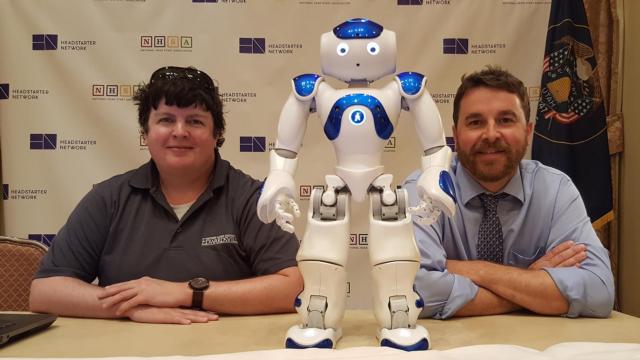
EDWARDSVILLE - Southern Illinois University Edwardsville researchers demonstrated how robots may shape the future of early learning during the 2017 Early Childhood Innovation Summit held June 26-28 in Salt Lake City, Utah.
Get The Latest News!
Don't miss our top stories and need-to-know news everyday in your inbox.
Stephen Hupp, PhD, professor of psychology in the SIUE School of Education, Health and Human Behavior, presented during the conference alongside student Ehren Wolfe, who is pursuing a master’s in computer science. The two are working on a collaborative research effort, led by Jerry Weinberg, PhD, associate provost for research and dean of the SIUE Graduate School, that focuses on teaching children about social-emotional skills within educational curriculum.
“This was only the second Early Childhood Innovation Summit hosted by the National Head Start Association, and we were proud to be involved,” said Hupp.
“Attending this conference offered a great opportunity to share with educators our ideas for future learning with robots,” added Wolfe. “Our work is an innovative idea that expands on the existing social emotional learning curriculum.”
Involved in the presentation, entitled “Tech Time: Robots as Co-Teachers,” was Mo, a humanoid robot also called NAO. The researchers have been using the Second Step curriculum to teach kids social-emotional skills through interaction with Mo, whose movements, expressions and behaviors are strategically programmed by Wolfe.
“We shared with the educators talking points that helped define the goals of our lesson and showed how it fits within existing curriculum,” Wolfe explained. “We also discussed teacher expectations and shared our anecdotal experience and similar research that addresses concerns, and provides a reference point for this new concept.”
According to the researchers, this project will continue, with future possibilities of external funding that would allow the team to systematically see if the robot can help children learn social-emotional skills.
“We don’t expect robots to take over teaching,” Wolfe said. “Instead, we’re hoping robots can be effective co-teachers, meant to motivate learners and provide them with a connection to innovative technology.”