
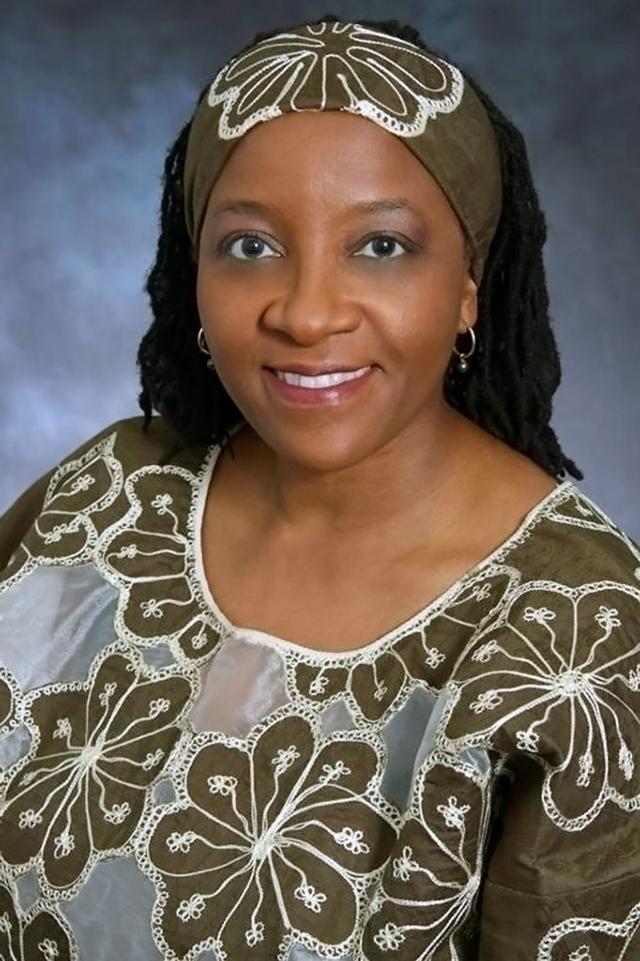
 EDWARDSVILLE - The challenges of growing black and female in apartheid South Africa has led Nontombi Naomi Tutu to her present as an activist for human rights. Those experiences taught how much we all lose when any of us is judged purely on physical attributes. In her speeches she blends the passion for human dignity with humor and personal stories.
Tutu is the third child of Archbishop Desmond and Nomalizo Leah Tutu. She was born in South Africa and has also lived in Lesotho, the United Kingdom and the United States. She was educated in Swaziland, the US and England, and has divided her adult life between South Africa and the US. Growing up the “daughter of ...” has offered Naomi Tutu many opportunities and challenges in her life. Most important of these has been the challenge to find her own place in the world. She has taken up the challenge and channeled the opportunities that she has been given to raise her voice as a champion for the dignity of all.
Get The Latest News!
Don't miss our top stories and need-to-know news everyday in your inbox.
Tutu's professional experience ranges from being a development consultant in West Africa, to being program coordinator for programs on Race and Gender and Gender-based Violence in Education at the African Gender Institute at the University of Cape Town. In addition she has taught at the Universities of Hartford and Connecticut and Brevard College in North Carolina.
Tutu started her public speaking as a college student at Berea College in Kentucky in the 1970's when she was invited to speak at churches, community groups and colleges and universities about her experiences growing up in apartheid South Africa. Since that time, she has become a much sought after speaker to groups as varied as business associations, professional conferences, elected officials and church and civic organizations. She has also led Truth and Reconciliation Workshops for groups dealing with different types of conflict. Together with Rose Bator she presents a workshop titled “Building Bridges” dealing with issues of race and racism. The two also lead women's retreats through their organization Sister Sojourner. They are also writing a book provisionally titled “I Don't Think of You as Black: Honest Conversations on Race and Racism”.
In addition to speaking, Tutu is a consultant to two organizations that reflect the breadth of her involvement in issues of human rights. The organizations are the Spiritual Alliance to Stop Intimate Violence (SAIV), founded by renowned author Riane Eisler and Nobel Peace Prize Laureate Betty Williams, and the Foundation for Hospices in Sub-Saharan Africa (FHSSA).
Tutu is a single mother of two children and currently lives in Nashville, TN.
About MJCHF
Our mission is to create communities that embrace respect, dignity, understanding and forgiveness among people of different cultures, races, and religion. The Mannie Jackson Center for the Humanities and the Foundation seek to inspire civility in political discourse by finding ways to unite those of different viewpoints. The world has grown increasing pluralistic and is increasingly polarized. We seek to create conversations that help create understanding and inspire others to recognize inequities and develop ways to correct them collaboratively.
Funds raised throughout the year from events such as our distinguished speaker’s series, help support the efforts of the Mannie Jackson Center for the Humanities, which conducts activities aimed at finding solutions to social and human problems such as poverty, energy and water needs, and educational inequities.
Recent regional activities of the MJCH and MJCHF include:
- (Education) Conversations Toward a Brighter Future – This ongoing educational activity brings together middle and high school youth to address ways to promote respect, dignity, understanding, and forgiveness in their own communities. Students convene at the Center and participate in discussions around how to treat each other to exist as a thriving society. They then go back to their schools to create action plans to yield positive results in their communities. Student groups can earn up to $5,000 to fund their two-year projects to be implemented in their home communities.
- (Education) The Alma Aitch STEM Center opened in the fall of 2016 as the MJCH’s new hub for STEM activities. It offers an innovative exploration of the ways in which enduring humanistic questions can influence student interest in STEM inquiry. The MJCH intended to facilitate programming to help students solve the world’s social problems through science and technology with a focus on humanistic perspectives.
- (Engagement/Education) Madison County Law Enforcement Initiative is a local task force aimed at increasing minority recruitment and retention of law enforcement officers in Madison County, Illinois. The initiatives
Recent global projects of the Center include:
- (Engagement) The Future of Transboundary Water Management – Empowering Informed Water Resources Policy and Practice with Big Data was the MJCH’s first international symposium (Oct. 12, 2017, Washington, D.C.), which was an impressive collaboration of presenters who discussed the implications of big data management from the conflict-torn Jordan River in the Middle East, to the complicated water rights of the Western United States, to the Mississippi River’s cyclic drought and abundance. The summit convened key capacity and community-builders on a national and international scale, well positioned to make immediate and measureable impacts.
- (Research) Mapmaking and Storytelling: A Socio-Ecological Atlas of Community College Districts Along the Mississippi River – The MJCH’s first Humanities/Environmental Sciences research engagement is a project that combines quantitative and qualitative information to improve human understanding of the relationships between people and places, and to help inform policy, planning, and management to improve regional development and place-making. Community characterization will help determine the potential for economic development, capacity building, infrastructure investment, community vulnerability, and resiliency.
More information about our efforts can be found at www.lc.edu/manniejackson and www.mjchf.org.