
COLLINSVILLE - When the task seems overwhelming, the uncertainty of how to begin keeps many people from acting. University of Illinois Extension 4-H specialist Curt Sinclair isn’t one of those people.
Get The Latest News!
Don't miss our top stories and need-to-know news everyday in your inbox.
Carbon neutrality and nutrient runoff are complex issues.
“We need to become ‘carbon neutral’ by producing less CO2 gas and finding new ways to absorb and hold these carbon molecules so they don’t get trapped in the atmosphere which adds to the warming of our planet,” Sinclair says. “At the same time, we need to reduce stormwater runoff to improve water quality.”
But where to begin? Sinclair has a good answer: plant trees.
The 2020-2030 Illinois Forest Action Plan, part of the Food, Conservation, and Energy Act of 2008, outlines the benefits of trees to Illinois residents.
“More trees will move us closer to cleaner water, healthier soils, more animals and birds, greater biological diversity, and cleaner air,” Sinclair says. “All these are critical to people’s health and quality of life.”
Illinois once held 14 million acres of trees, according to Sinclair. That number dropped to 3 million acres before intentional efforts 50 years ago began to reverse the decline. Today, Illinois has 5 million acres of trees.
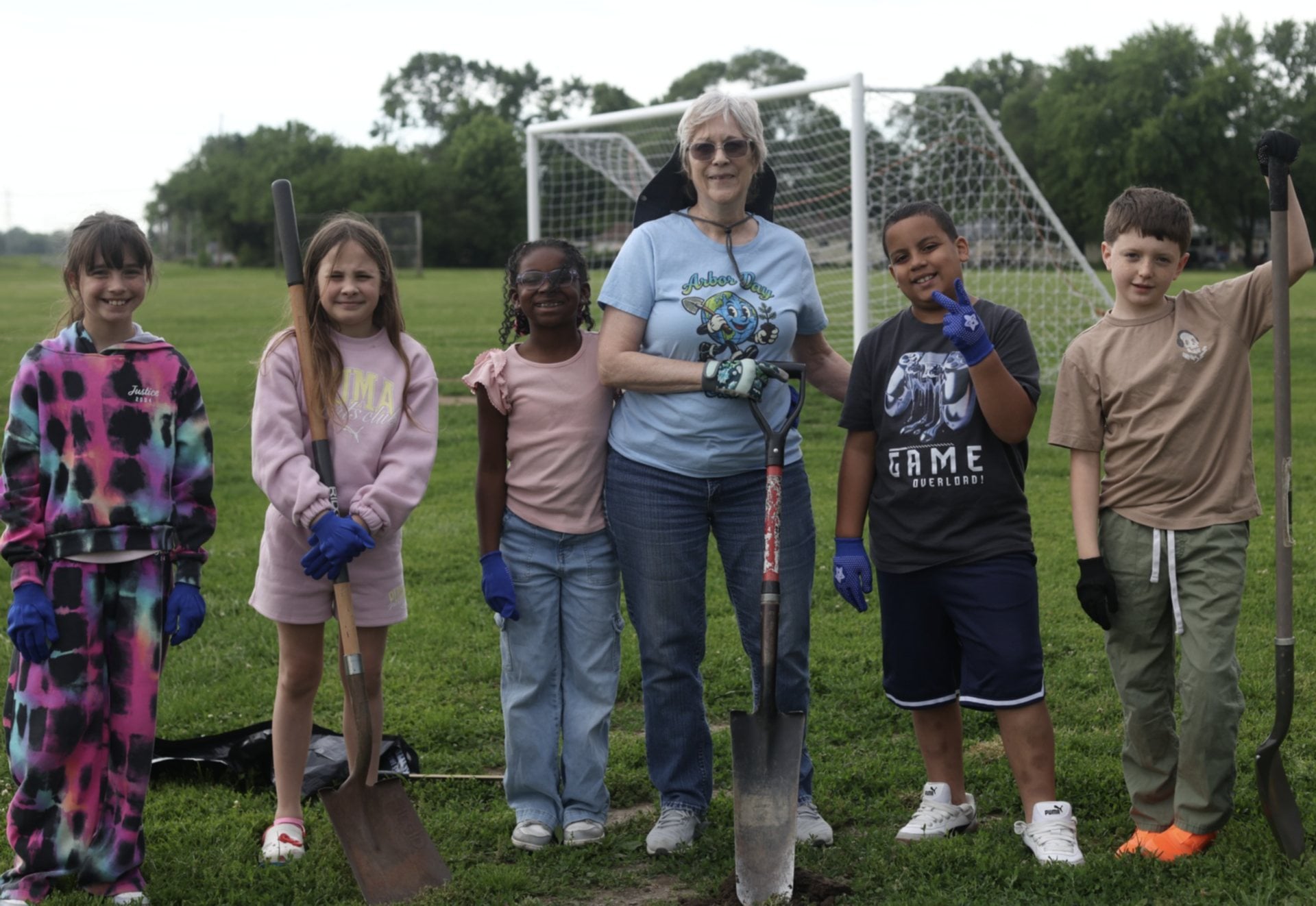
Sinclair is working with Illinois 4-H members and the Association of Illinois Soil and Water Conservation Districts to increase that number. The effort, 4-H Green Communities Tree Program, is support by grant funds from the Illinois Forestry Development Council and focuses on action, education, and conservation.
In the spring of 2022, 4-H youth in 31 Illinois counties will each plant a grouping of 25 oak trees on public properties in their county. The groups, called savanna, will bring new life to oak-hickory forests currently under threat in Illinois.
“Oak savannas are being overtaken by invasive species, as well as more shade-tolerant trees, such as maples,” Sinclair says. In addition, the decrease of beneficial disturbances, such as prescribed fires and proper timber management, also threatens large, mature oak trees.
“Illinois 4-H is primed to take action to increase the number of oak trees in the state,” Sinclair says. “The natural world is talking to us, and Illinois 4-H is primed to listen, learn, and act.”
The 4-H Green Communities Tree Program follows the "learn-by-doing" philosophy of 4-H and is guided by the priorities of the Illinois Forest Action Plan. Learn more about Illinois 4-H at go.illinois.edu/illinois4H.
Participating counties include: Adams, Bureau, Coles, DeKalb, Edwards, Franklin, Henry, Jackson, Jefferson, Kane-DuPage, Knox, Massac, McDonough, McHenry-Lake, Mercer, Monroe, Ogle, Peoria, Perry, Piatt, Pulaski-Alexander, Rock Island, Saline, St. Clair, Stark, Stephenson, Vermilion, Williamson, Winnebago, and Woodford.
WRITER: Judy Mae Bingman, Illinois Extension Communications and Marketing Manager
SOURCE: Curt Sinclair, Illinois Extension 4-H Natural Resources and Shooting Sports Specialist
ABOUT EXTENSION: Illinois Extension leads public outreach for University of Illinois by translating research into action plans that allow Illinois families, businesses, and community leaders to solve problems, make informed decisions, and adapt to changes and opportunities