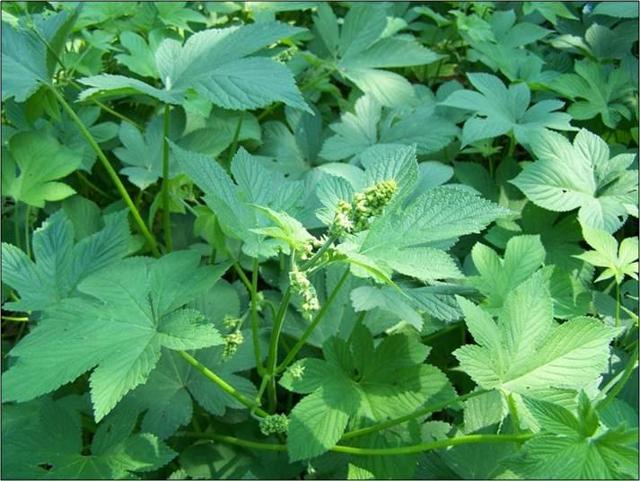
 EAST ALTON – New research findings from local Terrestrial Ecologist Lyle Guyon are changing the game for Japanese hops control and management in large floodplains.
Guyon, who holds a doctorate in Natural Resources and Environmental Sciences from the University of Illinois at Urbana-Champaign, is a senior scientist at Lewis and Clark Community College’s National Great Rivers Research and Education Center (NGRRECsm) and has over 15 years of experience in floodplain research.
Get The Latest News!
Don't miss our top stories and need-to-know news everyday in your inbox.
His recent paper, “Japanese Hops (Humulus japonicus) Control and Management Strategies in Large River Floodplains” was published in the Journal of Forestry earlier this spring.
“Japanese hops is a fairly new invasive species that many individuals may not be familiar with,” Guyon said. “Unfortunately, it is spreading rapidly and can create a real problem where it takes hold.”
His research findings show that the most effective long-term strategy to manage Japanese hops invasion is to pair post-emergent herbicide treatments with tree plantings to restore the floodplain forests to closed-canopy.
 “Findings from this study will help guide efforts by natural resource managers and landowners, not just in the local Riverbend community, but throughout the Upper Mississippi River watershed,” Guyon said.
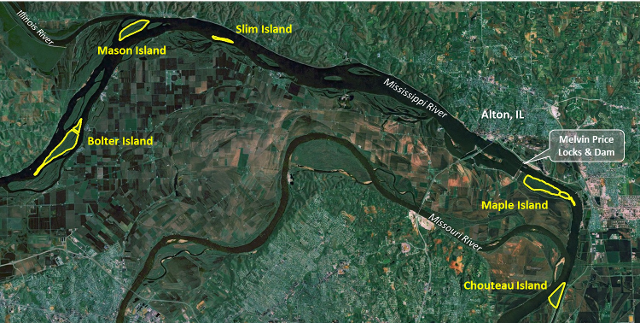
The study, conducted in partnership with the U.S. Army Corps of Engineers and Great Rivers Cooperative Ecosystem Studies Unit, was conducted from 2012-2015 on five different island sites along the confluence of the Illinois, Missouri and Mississippi Rivers.
The study compared different herbicide treatments and tree planting methods to determine which method may work the best when used on Japanese hops.
The three strategies included:
- Pre-emergent, or treating the site before Japanese hops have emerged from the soil
- Post-emergent, or after the plants have emerged
- Both pre- and post-emergent
At all management sites, eastern cottonwood and American sycamore bare root and containerized trees were also planted as part of the study, since Japanese hops is a shade-intolerant species.
Data suggests that herbicide treatments in floodplain forests are only a short-term solution because with each new flood, new Japanese hops seeds are added back into the soil and are able to sprout once the water recedes. Field observations indicate that reforesting an area is likely a more effective long-term control method.
“I hadn’t even encountered Japanese hops before I started working in the Mississippi River floodplains about 15 years ago, but immediately thought ‘wow – this is going to be a problem,’ when I finally did,” Guyon said. “It seemed like not a lot of folks were giving it the attention I thought it deserved, so I took a more active interest in researching control and management options.”
Guyon said any landowner who comes across Japanese hops should get rid of it immediately. “Hand pulling, mowing and/or spot herbicide treatment can all be effective for smaller outbreaks,” he said.
Guyon’s published paper is available through the Journal of Forestry at https://doi.org/10.1093/jofore/fvab055
For more information contact him at lguyon@lc.edu.
National Great Rivers Research and Education Center (NGRREC)
Founded in 2002 as a collaborative partnership between the University of Illinois at Urbana-Champaign and Lewis and Clark Community College, NGRREC is dedicated to the study of great river systems and the communities that use them. The center aspires to be a leader in scholarly research, education, and outreach related to the interconnectedness of large rivers, their floodplains, watersheds, and their associated communities. To learn more about NGRREC, visit www.ngrrec.org.