
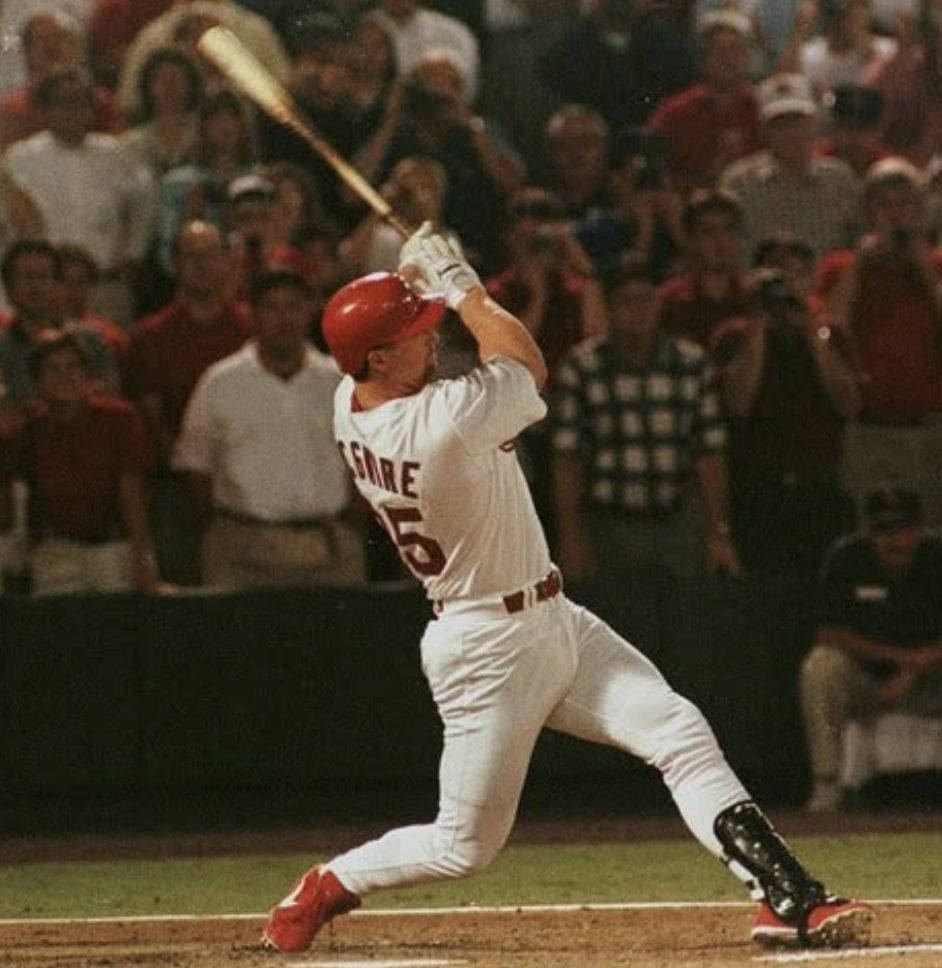
September 8 is a date that has produced defining moments across sports, but none carries a stronger connection to the St. Louis region than Mark McGwire’s 62nd home run in 1998. Before a packed Busch Stadium crowd, the Cardinals first baseman hit a fourth-inning drive off Chicago Cubs pitcher Steve Trachsel to pass Roger Maris’ 37-year-old single-season major league record of 61. St. Louis beat Chicago 6-3, but the score was secondary on a night when a Cardinals-Cubs game became a national event. Sammy Sosa, McGwire’s friendly rival in the home run chase, ran in from right field to congratulate him, and the Maris family joined the on-field celebration. McGwire finished that season with 70 homers. He later acknowledged using performance-enhancing drugs during his career, a disclosure that has remained central to discussions of the period, but the immediate scale of the September 8 moment and its place in St. Louis sports memory are unmistakable.
The date’s wider history begins in England in 1888, when the first fixtures of the Football League were played. Ten clubs took the field in five matches on September 8; two of the 12 founding members, Blackburn Rovers and Notts County, began their schedules a week later. The league format gave leading clubs from England’s Midlands and North a reliable, home-and-away competitive structure rather than a calendar made up chiefly of friendlies and cup ties. Preston North End opened with a 5-2 victory over Burnley and went on to win the inaugural league championship without losing a match. That first season helped establish the regular league model that became fundamental to professional soccer in England and, eventually, throughout much of the sport’s world.
Get The Latest News!
Don't miss our top stories and need-to-know news everyday in your inbox.
On September 8, 1957, Althea Gibson won the women’s singles championship at the U.S. National Championships, the tournament now called the U.S. Open. Gibson defeated Louise Brough 6-3, 6-2 on the grass courts at Forest Hills, N.Y., becoming the first Black woman to win the event. Her breakthrough came two months after she had become the first Black champion in Wimbledon singles. Gibson had faced exclusion and limited opportunity early in her career, yet her skill took her to the top of amateur tennis. The 1957 U.S. title was not simply another major trophy; it was a barrier-breaking achievement that expanded the image of who could lead the sport on its biggest stages.
Rome hosted another landmark on September 8, 1960. Wilma Rudolph anchored the United States women’s 4x100-meter relay team to Olympic gold in 44.5 seconds, ahead of the Unified Team of Germany and Poland. The relay victory completed a remarkable Games for Rudolph, who had already won the 100- and 200-meter titles. She became the first American woman to win three gold medals in track and field at one Olympics. Rudolph’s status as an international star was especially striking given that she had worn a leg brace as a child after illnesses that included polio. Her three-gold performance made her one of the defining athletes of the Rome Games and an enduring figure in American track and field.
Baseball added an unusual feat to the date in 1965, when Kansas City Athletics shortstop Bert Campaneris played all nine defensive positions in one game against the California Angels. Campaneris started at shortstop and rotated through the infield, outfield, catcher and pitcher during the first nine innings at Municipal Stadium. He allowed one run while pitching the eighth, then returned behind the plate in the ninth and held onto the ball for an out at home despite a collision that forced him from the game. The Angels ultimately won 5-3 in 13 innings, but Campaneris had already become the first major leaguer to complete a nine-position game. The stunt reflected owner Charlie Finley’s flair for promotion, but it also fit Campaneris’ exceptional athletic versatility.
Four decades later, September 8 belonged to Roger Federer at the U.S. Open. In a rain-delayed 2008 men’s final, Federer beat Andy Murray 6-2, 7-5, 6-2 to win the tournament for the fifth consecutive year. The run set an Open Era record for consecutive men’s singles titles at Flushing Meadows. Federer had lost the world No. 1 ranking to Rafael Nadal shortly before the tournament, adding importance to his response in New York. By beating Murray, who was playing in his first major final, Federer again showed the hard-court command and poise that made his 2004 through 2008 run one of the most dominant stretches in U.S. Open history.
On September 8, 2018, Naomi Osaka defeated Serena Williams 6-2, 6-4 to win the U.S. Open women’s singles title and become the first Japanese player to capture a major singles championship. Osaka, then 20 and playing in her first Grand Slam final, handled the occasion with powerful baseline play and steady serving. The match also included highly publicized code violations assessed to Williams, which became a major part of the postmatch conversation. Still, the result introduced Osaka as a major champion and marked a watershed for Japanese tennis. Her victory in Arthur Ashe Stadium began a championship career that soon included more major titles and the world No. 1 ranking.
The following year, on September 8, 2019, Rafael Nadal survived Daniil Medvedev’s comeback bid to win the U.S. Open men’s title 7-5, 6-3, 5-7, 4-6, 6-4. Nadal had led by two sets before Medvedev forced a deciding set in a final that lasted nearly five hours. Nadal broke serve for a 3-2 lead in the fifth and protected it to earn his fourth U.S. Open crown and 19th major singles championship. The victory moved him within one major of Federer’s then-record total of 20 and underscored Nadal’s ability to adapt his clay-court reputation into elite success on hard courts. From the first English league matches to a night that electrified St. Louis, September 8 has repeatedly shown how a single performance can become part of sports history.
This Day in Sports History: September 9
September 9, 1960, marked a beginning that helped reshape professional football. The Denver Broncos defeated the Boston Patriots 13-10 in Boston in the first regular-season game in American Football League history. The AFL entered a crowded football landscape as a direct challenger to the established NFL, with eight original teams, new markets and a willingness to compete aggressively for players and fans. Its first official game was close, but the larger result was the launch of a league that would force a merger with the NFL less than a decade later. That merger produced the modern AFC, helped make the Super Bowl the sport’s central event and expanded the national reach of pro football. Denver quarterback Frank Tripucka threw a 59-yard touchdown pass to Al Carmichael for the AFL’s first regular-season touchdown, making the night more than an opening kickoff. It was the first chapter of a successful challenge to football’s old order.
Five years later, on September 9, 1965, Sandy Koufax delivered one of baseball’s defining pitching performances. The Los Angeles Dodgers left-hander threw a perfect game in a 1-0 victory over the Chicago Cubs at Dodger Stadium, retiring all 27 batters and striking out 14. The game was also an extraordinary duel with Cubs pitcher Bob Hendley, who allowed only one hit. Los Angeles scored its only run after Lou Johnson walked, stole third and came home on a throwing error. Koufax’s performance was the eighth perfect game in major league history and his fourth career no-hitter, then a major league record. He had thrown a no-hitter in each of the previous three seasons, a run that illustrated both his dominance and remarkable consistency. Koufax would win the 1965 Cy Young Award, and his September masterpiece remains a standard for pitching excellence.
On September 9, 1968, Arthur Ashe won the first US Open men’s singles championship, defeating Tom Okker of the Netherlands in five sets at Forest Hills, New York. Ashe’s victory came in the inaugural US Open, which brought professionals and amateurs into the same national championship during tennis’ new Open era. As an amateur and an Army lieutenant, Ashe was not eligible to accept the first-prize money; it went instead to Okker. But the trophy carried a far greater historical weight. Ashe became the first Black man to win a Grand Slam singles title. His achievement expanded the possibilities for athletes who had long faced exclusion in tennis, and it helped establish a platform he later used in advocacy for racial equality, education and human rights. Ashe would add Australian Open and Wimbledon singles titles and became one of the sport’s most enduring figures.
September 9 was again a major date for tennis in 1974, when Billie Jean King outlasted Evonne Goolagong 3-6, 6-3, 7-5 to win the US Open women’s singles title. It was King’s final US Open singles crown and her fourth U.S. national championship overall, following victories in the old U.S. Championships and the Open era. The final reflected the quality and depth of an era in which King was both a leading player and a leading advocate. Just one year after her nationally watched victory over Bobby Riggs in the “Battle of the Sexes,” King’s comeback win against Goolagong reinforced her standing as a champion at the center of the push for greater opportunity and equal prize money in women’s tennis. Goolagong, a seven-time major champion, reached four consecutive US Open finals from 1973 through 1976 but never captured that title.
In a milestone with special meaning across the St. Louis region, the Cardinals retired Lou Brock’s No. 20 on September 9, 1979, during his final major league season. Brock had become one of baseball’s most dynamic leadoff hitters after arriving in St. Louis in a 1964 trade with the Cubs. By the time of the ceremony, he had surpassed 3,000 career hits and stood as baseball’s career stolen-base leader with 938, a record later broken by Rickey Henderson. Brock’s speed changed games, but his value extended well beyond stolen bases. He helped the Cardinals win World Series championships in 1964 and 1967, batted .391 in 21 World Series games and brought an aggressive style that made the running game central to the club’s identity. His No. 20 remains among the Cardinals’ retired numbers, a lasting marker of a player whose accomplishments still resonate in St. Louis.
On September 9, 1990, 19-year-old Pete Sampras announced himself on one of tennis’ biggest stages. Sampras defeated fellow American Andre Agassi 6-4, 6-3, 6-2 in the US Open final, becoming the youngest men’s singles champion in tournament history at 19 years, 28 days. Seeded 12th, Sampras had already beaten Ivan Lendl in the quarterfinals and John McEnroe in the semifinals before meeting Agassi in an all-American final. His powerful serve-and-volley game controlled the championship match and brought him his first major title. It also began a career closely tied to the US Open: Sampras won the event five times and later concluded his professional career with another US Open title in 2002, again defeating Agassi. He finished with a then-record 14 major singles championships and remains one of the game’s foremost champions.
The newest landmark on this date came on September 9, 2023, when Coco Gauff rallied past Aryna Sabalenka 2-6, 6-3, 6-2 to win the US Open women’s singles title. Gauff, 19, recovered after a difficult first set and used her speed, defense and composure to turn the match in front of a home-country crowd in New York. It was her first Grand Slam singles championship and made her the first American teenager to win the US Open since Serena Williams in 1999. The victory also completed a sharp late-season rise for Gauff, who had won major tuneup events in Washington and Cincinnati before arriving in New York. Her championship connected September 9 to another generation of American tennis history, showing again how a single date can hold beginnings, breakthroughs and performances that endure long after the final score.
