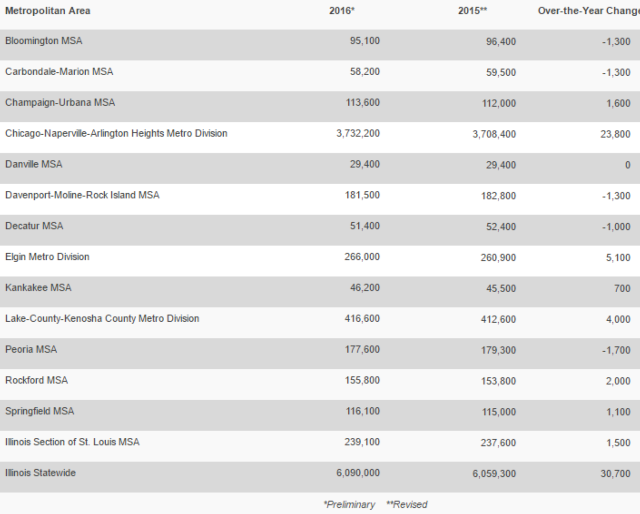

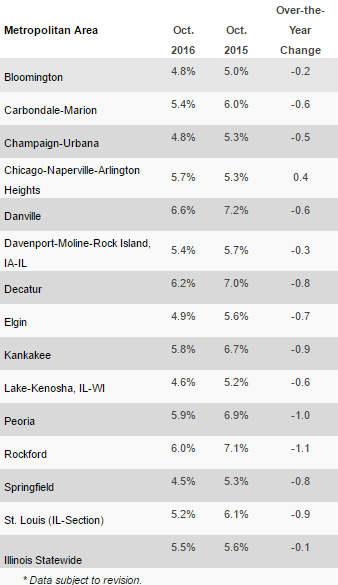
 CHICAGO– Thirteen of (14) Illinois’ metropolitan (metro) areas experienced decreases in their over-the-year unemployment rates and eight of the metro areas had increases in nonfarm jobs, according to preliminary data released today by the U.S. Bureau of Labor Statistics (BLS) and the Illinois Department of Employment Security (IDES). The unemployment rate increased only in the Chicago metro area.
Get The Latest News!
Don't miss our top stories and need-to-know news everyday in your inbox.

“Overall the year over year unemployment rate increase is disappointing, but not unexpected given Illinois’ lackluster rate of economic recovery since 2011,” said IDES Director Jeff Mays. “ Each of the six counties in the Chicago metro division saw their unemployment rate increase, while 94 of the remaining 96 counties in the state saw their rates decline.”
Illinois businesses added jobs in eight metro areas, in which the largest increases were seen in: Elgin Metropolitan Division (+2.0%, +5,100), the Kankakee MSA (+1.5%, +700) and the Champaign-Urbana MSA (+1.4%, +1,600). Total nonfarm jobs in the Chicago-Naperville-Arlington Heights Metro Division increased +0.6% or +23,800. Illinois businesses lost jobs in five metro areas including Carbondale-Marion MSA (-2.2%, -1,300), the Decatur MSA (-1.9%, -1,000) and the Bloomington MSA (-1.3%, -1,300). The industries that saw job growth in a majority of metro areas were Retail Trade (10 areas), Educational and Health Services (8 areas), Leisure and Hospitality (8 areas) and total Government (8 areas). Manufacturing saw decreases in 12 areas.
Not seasonally adjusted data compares October 2016 with October 2015. The not seasonally adjusted Illinois rate was 5.5 percent in October 2016 and stood at 12.2 percent at its peak in this economic cycle in January 2010. Nationally, the not seasonally adjusted unemployment rate was 4.7 percent in October 2016 and 10.6 percent in January 2010 at its peak. The unemployment rate identifies those who are out of work and looking for work, and is not tied to collecting unemployment insurance benefits.