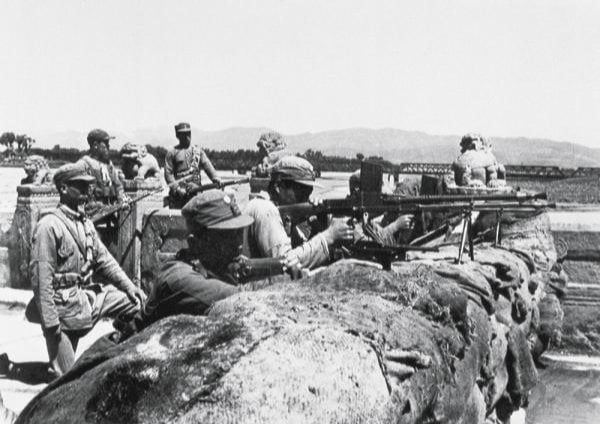
On July 7, one of the most significant events in world history took place in 1937, when fighting between Chinese and Japanese forces at the Marco Polo Bridge near Beijing helped trigger the full-scale Second Sino-Japanese War. The clash began as a local military incident, but it quickly grew into a much larger conflict between China and Japan. At the time, it mattered because it opened years of devastating war in East Asia, brought immense civilian suffering, and reshaped regional power. It still matters today because the war became part of the wider chain of events that fed into the Second World War, and its memory continues to shape how East Asian history is understood.
Get The Latest News!
Don't miss our top stories and need-to-know news everyday in your inbox.
The Marco Polo Bridge Incident did not happen in isolation. Tensions had been building for years after Japan’s expansion into Manchuria in 1931 and the creation of the puppet state of Manchukuo. By July 1937, armed forces from both countries were operating in a tense and unstable environment near Beijing. When a Japanese soldier was reported missing after night maneuvers, demands to enter the nearby Chinese town of Wanping led to gunfire and then open combat. Although the missing soldier later returned, the crisis had already moved beyond a simple misunderstanding. What followed was a major war that lasted until 1945, drew in vast resources and populations, and left a deep mark on modern Chinese and Japanese history.
Several centuries earlier, this date also marked an important turning point in Europe. In 1456, the retrial of Joan of Arc ended with her formal exoneration by the Catholic Church. She had been executed in 1431 after a trial during the Hundred Years’ War, but many had long questioned the fairness of the original proceedings. The new judgment overturned the earlier verdict and declared that the first trial had been deeply flawed. This mattered not only for Joan’s reputation, but also for the French monarchy, which had benefited from her military support. Over time, her story became one of the best-known examples of how politics, religion, and war could shape justice.
A different kind of political change came on July 7, 1807, when the Treaties of Tilsit were concluded after Napoleon Bonaparte’s victory over Russia and Prussia. Meeting with Tsar Alexander I, Napoleon reshaped alliances in Europe and reached terms that temporarily placed France at the center of continental power. Prussia was weakened, and Russia entered a more cooperative relationship with France, at least for a time. The agreements did not bring lasting peace, but they showed how much Europe had been transformed by the Napoleonic Wars. They also set the stage for later tensions when the French and Russian empires eventually moved back toward conflict.
By the late 19th century, July 7 became linked with another episode of imperial rivalry. In 1898, the United States formally annexed Hawaii. American political and business influence in the islands had grown for decades, and the overthrow of Queen Lili'uokalani in 1893 had already shifted power into the hands of a provisional government that favored annexation. Supporters in the United States saw Hawaii as strategically valuable in the Pacific, especially for trade and naval operations. For Native Hawaiians, however, annexation was tied to the loss of sovereignty and self-rule. The event remains historically significant because it reflected broader patterns of expansion, commerce, and power in the Pacific world.
On July 7, 1981, U.S. President Ronald Reagan announced the nomination of Sandra Day O’Connor to the Supreme Court. Though a legal and political event rather than a scientific one, it represented another kind of institutional innovation: the first woman chosen for the nation’s highest court. Her appointment reflected gradual changes in public life and professional opportunity for women in the 20th century.
The world of culture and media saw one of its most memorable moments on July 7, 1969, when Canada’s Official Languages Act received royal assent. While this was a legal measure, it also affected education, public culture, and national identity by recognizing English and French as the country’s official languages at the federal level. The law aimed to address long-standing tensions between linguistic communities and to build a more inclusive public framework. Its legacy can still be seen in Canadian institutions, broadcasting, and civic life.
A key event in entertainment history came in 1954, when the first Elvis Presley single, “That’s All Right,” was played on the radio. The recording itself had been made days earlier at Sun Studio in Memphis. This moment helped launch one of the most influential careers in popular music and signaled the rise of rock and roll into mainstream culture. Presley’s early success brought together musical traditions rooted in blues, country, and gospel, and his breakout helped transform youth culture, recording, fashion, and global entertainment in the decades that followed.
Sports history on this date includes one of the most famous tennis finals ever played. On July 7, 1985, Boris Becker won Wimbledon at age 17, becoming the youngest male champion in the tournament’s history at the time. His victory drew attention not only because of his age, but because it marked the arrival of a new international sports star during a period when televised tennis was reaching broad global audiences. Becker’s win also showed how quickly young athletes could rise on the world stage.
Another major event from the 21st century gave this date a darker association. On July 7, 2005, coordinated bombings struck London’s public transport system, killing 52 people and injuring hundreds more. The attacks targeted ordinary commuters during the morning rush hour and brought shock and grief across the United Kingdom and beyond. In the immediate aftermath, the event led to emergency responses, investigations, and renewed debate over security and public safety. Its long-term significance lies in how it shaped discussion around urban vulnerability, counterterrorism, and the resilience of public life in large cities.
Among notable births, Marc Chagall, born on July 7, 1887, stands out for his distinctive and imaginative art. Working across painting, stained glass, stage design, and illustration, Chagall drew on folklore, religion, memory, and modernist experimentation. His dreamlike style made him one of the most recognizable artists of the 20th century, and his work connected personal identity with broader cultural change.
Also born on this date, in 1901, was Vittorio De Sica, the Italian filmmaker and actor whose work became central to postwar cinema. As a director, he helped define Italian neorealism through films such as Bicycle Thieves, which used ordinary lives and social hardship to tell powerful stories. His influence reached far beyond Italy and shaped later filmmakers around the world.
Ringo Starr, born in 1940, is remembered as the drummer of the Beatles and as a musician, singer, and actor in his own right. His playing style, personality, and role in one of the most influential bands in modern music history helped shape popular culture on a global scale. The Beatles changed recording, songwriting, and youth culture, and Starr remains an important part of that legacy.
In sports, Mahendra Singh Dhoni, born on July 7, 1981, became one of cricket’s best-known captains. Under his leadership, India won major international tournaments, and he earned a reputation for calm decision-making in high-pressure matches. His career reflects the growth of cricket as a major global sport and the increasing international reach of South Asian athletic culture.
This date also marks the birth of Pierre Cardin in 1922, a fashion designer whose work helped redefine postwar style. Known for bold shapes and futuristic designs, he also changed the business of fashion by expanding into branding and licensing on a global scale. His career showed how design, commerce, and mass culture became increasingly connected in the 20th century.
Notable deaths on July 7 include Arthur Conan Doyle, who died in 1930. He is best known as the creator of Sherlock Holmes, one of the most enduring fictional detectives in world literature. Doyle’s stories helped shape modern detective fiction, influenced film and television for generations, and introduced narrative methods that remain familiar to readers today.
Another major cultural figure lost on this date was Vivien Leigh, who died in 1967. Her performances in stage and screen productions, especially Gone with the Wind and A Streetcar Named Desire, made her one of the most admired actors of her era. Her work remains part of the history of 20th-century theater and film.
Henri Nestlé, who died in 1890, left a different kind of legacy. As an entrepreneur and developer of infant food products, he played a role in the growth of modern food manufacturing. The company associated with his name became one of the world’s largest food businesses, linking his career to the rise of global consumer industries.
July 7 brings together war and reconciliation, empire and reform, artistic invention and everyday resilience.