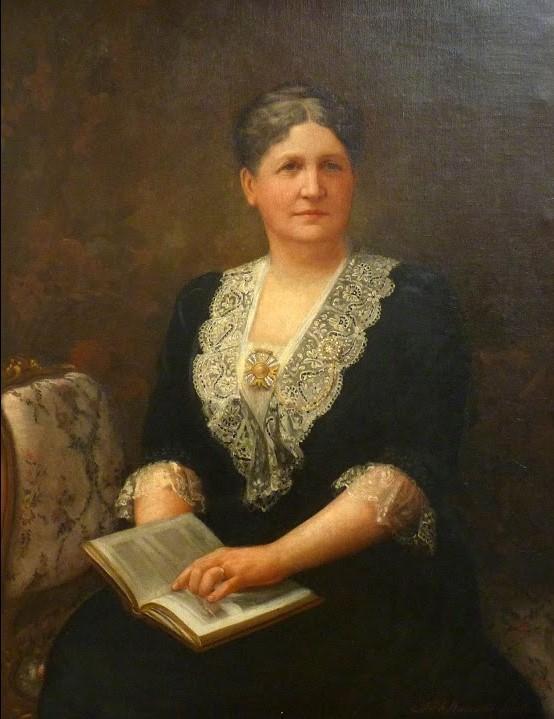
Morgan County native Ellen Hardin Walworth was a woman whose interests were both diverse and numerous. Her role in founding the Daughters of the American Revolution, though, is her greatest legacy.
Get The Latest News!
Don't miss our top stories and need-to-know news everyday in your inbox.
Walworth, who was born in Jacksonville on Oct. 20, 1832, was one of four women who established the D.A.R. in 1890, which continues today as one of the nation’s foremost female historical organizations. Along the way, she not only became an attorney and scientist, but also an accomplished historian.
Her intellect was a reflection of her upbringing. She was the oldest of four children to Jacksonville attorney John J. Hardin, a Kentucky native who had moved to Morgan County in 1831. The son of a United States senator, the younger Hardin was elected to Congress as a Whig in 1843 and was a political rival of Abraham Lincoln, despite the fact that he was a cousin to Lincoln’s wife, Mary Todd.
A three-term member of the Illinois House, Hardin was killed at Buena Vista during the Mexican-American War in February 1847. One of Ellen’s younger brothers, Martin, was an 1859 West Point graduate who rose to brigadier general in Civil War service.
After her father’s death, Ellen’s family stayed in Jacksonville until 1851, when her mother married Rueben Hyde Walworth, the last to hold the position of chancellor of the state of New York. The new family then moved to Saratoga Springs, N.Y. to live at the Walworth family estate, Pine Grove.
On July 29, 1852, Ellen married a stepbrother, Mansfield Tracy Walworth, his father’s youngest son. An attorney, the younger Walworth also achieved some measure of fame as a novelist. The union quickly produced six children, including daughter Reubena, who succumbed to typhoid fever while aiding Spanish-American soldiers at nearby Fort Monroe and Montauk Point in 1898. Inscribed on her tombstone are the words “she served her flag, not as a man, but better still, as only woman can.”
Clearly, she inherited those traits from her mother, whose patriotism was unquestioned. Unfortunately, Ellen was trapped in a volatile marriage, as her husband’s mental health steadily deteriorated and he became physically abusive. In 1861, she left him and moved her children to a farm near Louisville, Kentucky.
Several attempts at reconciliation followed before Ellen finally settled in Washington, D.C. in 1868, where she worked as a government clerk. After she lost the position, she returned to her husband, who continued to abuse her, even during her eighth pregnancy. In January 1871, she went back to Saratoga to seek a “limited divorce.”
There, she supported herself by converting the family home into a girls’ boarding school, which she managed for fifteen years. Still, Mansfield continued to threaten Ellen, and attempts by other family members to help were to no avail. Finally, Ellen’s oldest son, Frank, fatally shot his father in a New York City hotel room on June 3, 1873.
A celebrated trial followed in which Ellen testified in her son’s favor, but Frank received a life sentence that July 5. One source writes that Ellen “devoted herself to securing his release,” reading law to help overturn his conviction.
In 1877, a judge pardoned Frank, declaring he was not responsible for the murder by reason of insanity. Ellen actually earned a law degree from New York University in 1896, but never formally practiced.
By then, she was already a prolific historical writer, publishing accounts of the Burgoyne campaign in upstate New York while becoming an expert on the battlefields at Saratoga. From 1876-94, she served as the only female trustee of the Saratoga Monument Association, chairing the committee on tablets and raising funds to mark specific sites of the battle. In 1877, she created a guidebook for visitors to Saratoga.
Walworth also assisted in fund-raising to restore George Washington’s Mount Vernon estate and was one of the earliest voices to call for a National Archives by presenting a paper on the subject at the Chicago World’s Fair in July 1893. She was one of the first women in New York to serve on the board of education, though she eventually returned to the warmer climate of Washington, for health reasons.
In addition, she was an avid scientist and joined the American Association for the Advancement of Science in 1876, the first active female member of the organization.
In August 1880, she was one of only a handful of women to present a paper to the association, “Field Work by Amateurs,” and vocally called for more scientific work by amateurs, particularly women.
But women were still excluded in many fields, including historic preservation. In July 1890, the Sons of the American Revolution denied female membership, inducing four women, including Walworth, to found the Daughters of the American Revolution.
The first meeting of the new society was held in October 1890. From 1892-94, Walworth served as the first editor of the D.A.R.’s official publication, American Monthly Magazine, while holding the position of the group’s first secretary-general. Today, the D.A.R. numbers over 177,000 members.
She continued her dedication to patriotic values in 1898 by helping found the Women’s National War Relief Association to aid American troops from the Spanish-American War, serving as Director-General.
Walworth died in the nation’s capital on June 23, 1915, and is buried in Saratoga. In 1929, the D.A.R. dedicated a memorial to its four founders in Washington, while a marble bust of Walworth, created in 1913, is displayed at the organization’s Continental Hall nearby.
In her adopted hometown, the Saratoga Springs History Museum, which was co-founded by Ellen, is home to the Walworth Memorial Museum, a seven-room facility that interprets Walworth family history.
Tom Emery is a freelance writer and historical researcher from Carlinville. He may be reached at ilcivilwar@yahoo.com or 217-710-8392.
This story was originally printed in the March 2022 issue of The Prairie Land Buzz Magazine, a free magazine distributed monthly in 11 Illinois counties. For more information, additional stories and more, visit http://www.thebuzzmonthly.com.