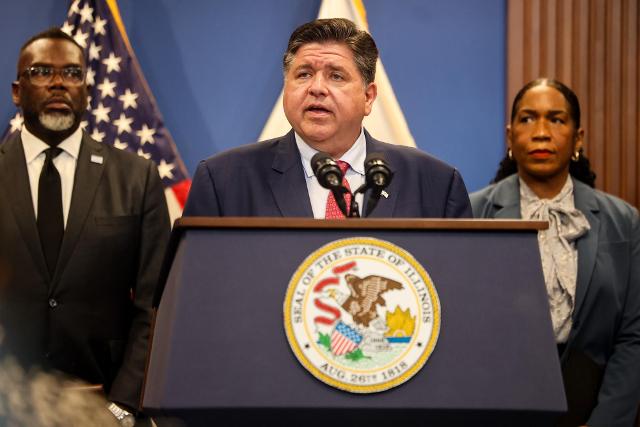
 CHICAGO – Today, Governor JB Pritzker signed into law three bills implementing more comprehensive orders of protection for survivors of domestic violence, identification and intervention protocols for cases of high-risk intimate partner violence, and expanded access to sexual assault nurse examiners across the state.
Get The Latest News!
Don't miss our top stories and need-to-know news everyday in your inbox.
“This legislation is designed to create safeguards against domestic and sexual violence, making us more prepared to stop it before it happens and step in upon its discovery,” said Governor JB Pritzker. “I am committed to supporting all survivors and connecting them with the resources needed to seek justice, receive care, and be empowered.”
“Domestic violence and sexual assault are two of the most heinous crimes an individual can commit. I’m proud of the strides we’re making to further protect Illinoisans in their most vulnerable moments,” said Lieutenant Governor Juliana Stratton. “Additional safeguards and closing legal loopholes are common sense policy to defend survivors of these crimes.”
The Governor signed the following bills into law:
- SB 3044: Strengthens protections for survivors of domestic violence and harassment by closing a legal loophole that occurs between emergency and final orders of protection(Sen. Stadelman/Rep. West); effective January 1, 2028
- SB 3048: Creates safeguards for those at the highest risk of being seriously injured or killed by an intimate partner (Sen. Morrison/Rep. Williams); effective January 1, 2027
- SB 3506: Expands access to Sexual Assault Nurse Examiners with telehealth options (Sen. Morrison/Rep. Cassidy); effective January 1, 2027, except that changes to Section 2 of the Sexual Assault Survivors Emergency Treatment Act are effective June 1, 2027 and changes to Section 8.5 of the Rights of Crime Victims and Witnesses Act are effective July 1, 2026
Closing Gaps in Protections for Survivors
In Illinois, survivors of domestic violence and stalking can receive emergency orders of protection that remain in effect between 14 and 21 days.
SB 3044 closes gaps in protection for survivors by ensuring emergency orders of protection remain in effect until the plenary, or final, order of protection has been served.
“This law was inspired by a constituent who showed how even a brief gap in protection can create real fear and risk for survivors,” said State Senator Steve Stadelman (D-Rockford). “Her experience helped drive this change, and I’m proud that Illinois has now taken action to ensure victims remain protected every step of the way.”
“Ensuring emergency protection orders go into effect the moment judges sign them can mean the difference between life and death for survivors facing violence and abuse,” said State Rep. Maurice West (D-Rockford) “Waiting until the order is officially served leaves those seeking protection vulnerable, whether that’s a few hours or a few days. Senate Bill 3044 closes this coverage gap so residents with emergency orders of protection experience the safest outcome possible.”
Identifying and Intervening in High-Risk Situations
First responders and law enforcement play a critical role in identifying high-risk domestic situations before they become fatal.
SB 3048 requires the use of the Lethality Assessment Protocol – an evidence-based screening process that identifies victims as high risk, connects them with domestic violence service providers at the scene, and seeks to prevent abuse dynamics from escalating to homicide.
SB 3048 requires officers to administer a lethality assessment if there is an allegation of intimate partner domestic violence that did not result in arrest, provided there is an allegation of assault or battery. The Illinois State Police (ISP) and the Illinois Department of Human Services (IDHS) will work with stakeholders to develop a tool kit and model policies for local agencies by January 1, 2028.
The law enacts the following measures:
- Requires a Lethality Assessment to be administered to all victims of domestic violence to evaluate the level of danger present
- Prohibits officers from administering the assessment until they have received specific training on how to use the tool kit
- Mandates that lethality assessments only be administered with the explicit consent of the victim; if the victim does not or cannot provide the information, officers must document the lack of assessment in the police report and refer them to a domestic violence center
- Exempts lethality assessments and related records are from public disclosure
- Prohibits law enforcement officers from listing the specific domestic violence center shared in a victim referral within probable cause or incident reports
“Domestic violence incidents are some of the most volatile situations police officers encounter, and identifying high-risk cases early is critical to protecting victims,” said Illinois State Police Director Brendan F. Kelly. “SB 3048 strengthens that effort by giving law enforcement the tools, training, and standardized guidance needed to assess danger in real time and assist individuals with life-saving resources. The Illinois State Police is committed to working with our partners to implement this protocol and help prevent these tragedies before they occur.”
“Far too often, domestic violence escalates to fatal consequences,” said State Senator Julie Morrison (D-Lake Forest). “Senate Bill 3048 gives law enforcement the tools and training they need to identify when a victim may be at the highest risk of serious harm and connect them with life-saving resources as quickly as possible.”
“Statistics show domestic violence homicides are increasing significantly, even as all other homicides are down,” said State Rep. Ann Williams (D-Chicago). “DV calls can be challenging for police officers as they must navigate volatile and unpredictable situations while ensuring the safety of the impacted individual. This toolkit helps equip officers to identify the highest risk situations and prioritize the safety of survivors both during and after an incident occurs.”
Expanding Access to Sexual Assault Examinations
The Sexual Assault Survivors Emergency Treatment Act (SASETA) is updated annually by a working group of medical professionals, advocates, and attorneys led by the Office of the Illinois Attorney General. Their efforts to address the shortage of sexual assault nurse examiners (SANE) resulted in this year’s amendments to allow exams administered by providers still in training with virtual supervision.
SB 3506 enacts the following measures to make sexual assault examinations more accessible across Illinois with telehealth options:
- Allows a hospital or approved pediatric health care facility to submit a plan for the use of a TeleSANE interactive telecommunications system to the Illinois Department of Public Health (IDPH)
- Clarifies that a medical forensic examination for a sexual assault survivor age 13 or older can be performed by a trained in-person examiner and supervised by a qualified medical provider through the use of a TeleSANE interactive telecommunications system
SB 3506 also clarifies language around patient consent for medical forensic examinations. In cases where a medical provider determines that a survivor is without decisional capacity, the patient can still receive an examination with the consent of a guardian, spouse, or power of attorney.
“Survivors of sexual assault deserve a system that puts their safety, dignity and access to care first,” said State Senator Julie Morrison (D-Lake Forest). “Senate Bill 3506 removes barriers to support, modernizes our response to survivors’ needs, and reaffirms our commitment to protecting survivors as they navigate healing and justice.”
“Survivors of sexual violence deserve to have access to high-quality care that respects their trauma and experiences,” said Rep. Kelly Cassidy (D-Chicago). “These reforms will strengthen the rights of victims and build upon programs meant to help ease their pathways to recovery. I’m grateful for all of our partners who worked to deliver justice for survivors of sexual violence across Illinois.”