
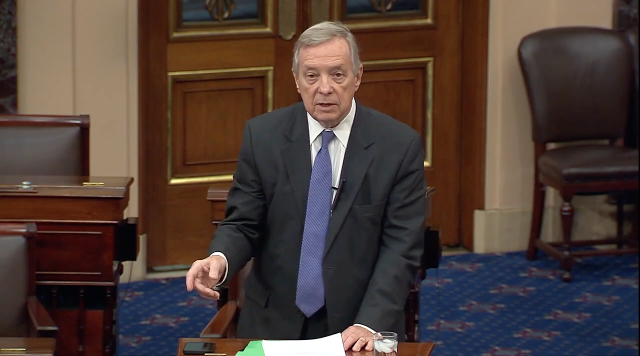
WASHINGTON – U.S. Senate Majority Whip Dick Durbin (D-IL), Chair of the Senate Judiciary Committee, sent a letter to the Department of Justice (DOJ) and Federal Trade Commission (FTC) encouraging them to use the authorities granted to them under the Clayton and FTC Acts to appropriately investigate interlocking directorates in the life science industry and take all necessary steps to combat this anticompetitive practice.
Get The Latest News!
Don't miss our top stories and need-to-know news everyday in your inbox.
An interlocking directorate occurs when an individual simultaneously serves on multiple corporate boards of directors. The practice can raise competition concerns, particularly when the individual serves on the boards of companies in the same industry or where the companies are competitors. Recent research suggests that anticompetitive interlocking directorates frequently happen in the life science industry, potentially resulting in coordination on pricing and other decisions that result in consumer harm.
Under the Clayton Act, it is illegal for a person to serve as a director or officer in any two competitor corporations at the same time if each of the corporations has capital, surplus, and undivided profits above an annually-adjusted statutory threshold. Firms with common directors are more likely to coordinate on price, product, advertising, and other decisions, leading to less competition and harm to consumers. Despite this prohibition, recent research out of Stanford University has found that a significant proportion of all life science companies are interlocked with actual or likely competitors. In 2020, the research showed that nearly 20 percent of the 2,241 public life science companies studied had interlocking boards, including 50 percent of high revenue firms. Additionally, they found hundreds of instances in which companies producing directly competitive drugs shared board members.
“We write to request that the Department of Justice Antitrust Division and the Federal Trade Commission (FTC) investigate troubling evidence that anticompetitive interlocking directorates are pervasive throughout the life science industry. The proliferation of interlocking directorates may have profound effects on consumers, including diminishing the extent to which companies conduct innovative research, reducing patient access to medications, and making prescription drug prices even more unaffordable… In light of the likelihood of competitive harm, Section 8 of the Clayton Antitrust Act has long made interlocking directorates among companies of sufficient size per se illegal. The FTC also recently emphasized that ‘interlocking directors . . . of competing firms not covered by the literal language of the Clayton Act’ may run afoul of Section 5 of the Federal Trade Commission Act (FTC Act),” the letter stated.
In the letter, Durbin praised the agencies for their recent efforts to crack down on interlocking directorates. In April 2022, Assistant Attorney General for Antitrust Jonathan Kanter stated that the Justice Department was “ramping up efforts to identify violations across the broader economy” and would “not hesitate to bring Section 8 cases to break up interlocking directorates.” This statement was followed by the Department’s October 2022 announcement that seven directors had resigned from corporate boards “in response to concerns by the Antitrust Division that their roles violated the Clayton Act’s prohibition on interlocking directorates.”
The letter continued, “Prices for prescription drugs are already higher in the United States than in any peer nation, with the median price for a new drug launched last year coming in at a staggering $222,000. Companies in the life science industry have frequently resorted to anticompetitive practices, such as pay-for-delay patent settlements, patent thickets, and illegal rebate schemes, to maintain those high prices. Interlocking directorates will only exacerbate the problem, with the potential for ‘fewer therapeutic avenues available to patients, increased drug prices, and fewer efficacious drugs developed.’ While your agencies have undertaken efforts to address some of the competition problems in the life science industry, more must be done. In particular, I encourage your agencies to use the authorities granted them under the Clayton and FTC Acts to investigate interlocking boards in the life science industry and take all necessary steps to combat this anticompetitive practice.”
Full text of today’s letter is available here.