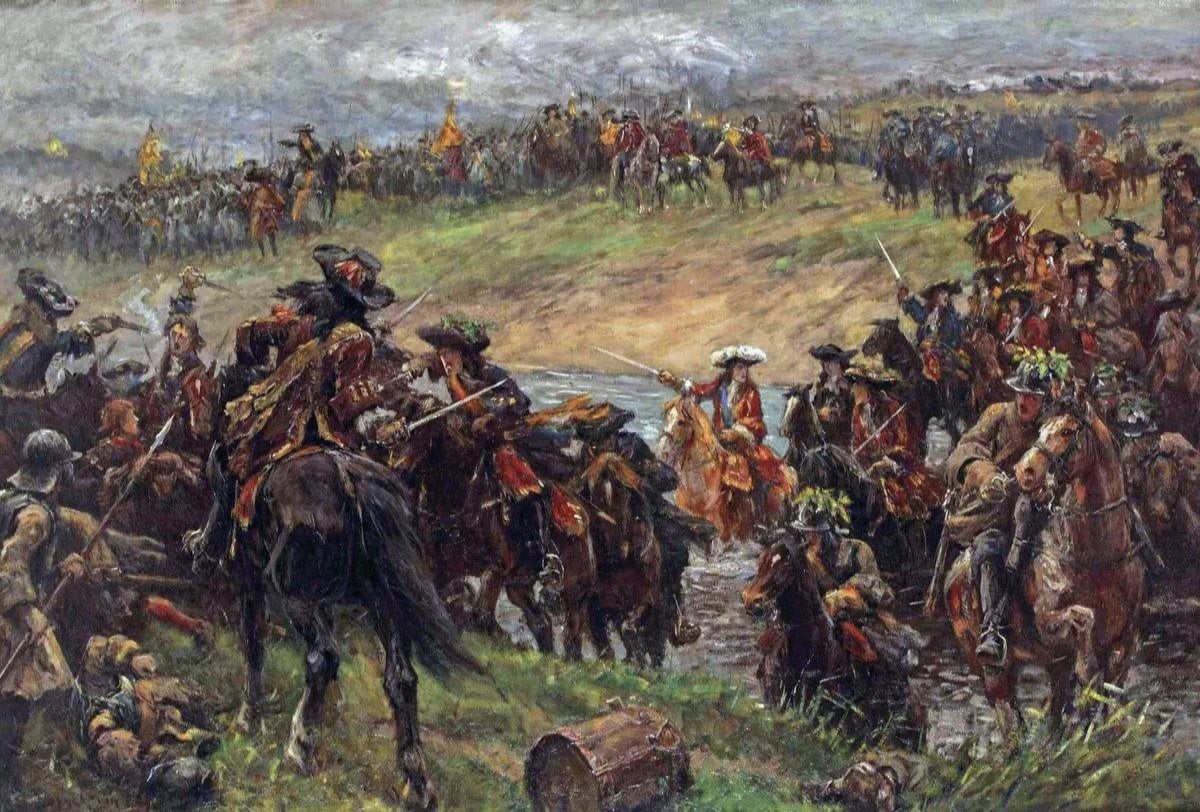
July 12 commemorates one of the most important events in world history in 1690, when William III defeated the deposed King James II at the Battle of the Boyne in Ireland. The battle was part of a larger struggle over who would rule the kingdoms of England, Scotland, and Ireland after the Glorious Revolution. At the time, it confirmed William’s hold on power and weakened James’s attempt to regain his throne. It still matters today because it shaped the political future of the British Isles, influenced relations between Britain and Ireland, and became a lasting point of memory in Irish history.
Get The Latest News!
Don't miss our top stories and need-to-know news everyday in your inbox.
The conflict behind the Battle of the Boyne began when James II, a Catholic king, was removed from power in 1688 and replaced by his Protestant daughter Mary II and her husband William of Orange. James did not accept this outcome and sought support, especially in Ireland and from France. When the two sides met near the River Boyne, William’s forces won a clear victory. Although the battle did not end the wider war immediately, it marked a turning point. In the years that followed, Protestant political control in Ireland became more firmly established, and the event took on deep symbolic importance that lasted for centuries.
More than a century later, this date brought another major political change in North America. On July 12, 1776, Captain James Cook began his third voyage from Plymouth, England. The expedition was intended to search for the Northwest Passage, a hoped-for sea route linking the Atlantic and Pacific Oceans through the far north. Cook was already one of the best-known explorers of his time, and this journey added greatly to European knowledge of the Pacific, Alaska, and the Arctic coast of North America. Though he did not find the passage, the maps and observations produced by the voyage influenced trade, science, and later imperial expansion.
A very different kind of turning point came in 1806, when the Confederation of the Rhine was established under the influence of Napoleon Bonaparte. This new grouping of German states weakened the old Holy Roman Empire, which soon afterward came to an end. The change mattered because it altered the political map of Central Europe and accelerated the long process of German reorganization. Napoleon’s actions were aimed at strengthening French power, but they also helped create new ideas about statehood, sovereignty, and national identity that would shape Europe in the nineteenth century.
On July 12, 1862, the U.S. Congress authorized the Medal of Honor during the American Civil War, a military event with wider historical meaning. While rooted in one nation’s conflict, it reflected the growing practice of formally recognizing individual service and bravery in modern warfare. Such honors became part of military culture in many countries, tying personal action to national memory.
War returned to the date in 1943 during the Second World War, when the Battle of Prokhorovka took place as part of the larger Battle of Kursk on the Eastern Front. Often remembered as one of the largest armored clashes in history, it occurred during Germany’s attempt to regain the initiative against the Soviet Union. The fighting was intense and costly. Although historians continue to debate some details of the battle’s scale and immediate effect, the wider Kursk campaign clearly ended German offensive momentum in the east. From that point on, the Soviet Union increasingly held the strategic advantage, which would matter greatly in the final defeat of Nazi Germany.
Culture and media have their place on this day as well. In 1962, the Rolling Stones played their first public performance at the Marquee Club in London. At the time, they were a young band among many in the British music scene. Over the years, they became one of the most influential rock groups in the world. Their early appearance on this date stands as a reminder of how cultural history often begins in small venues before reaching global audiences.
Only a few years later, in 1967, race-related unrest in Newark, New Jersey, began after the arrest and reported beating of a Black taxi driver. The violence and destruction that followed reflected deeper problems involving policing, housing, employment, and inequality in many American cities. Newark was one of several urban uprisings in the United States during that era. It remains important because it showed how long-standing social grievances can erupt when institutions lose public trust.
The late twentieth century brought major change in Africa. On July 12, 1975, São Tomé and Príncipe gained independence from Portugal. The islands had been part of the Portuguese colonial empire for centuries. Their independence came during a period when Portugal was withdrawing from its African colonies after political change at home. For São Tomé and Príncipe, the moment marked the beginning of self-government and placed the country within the broader history of decolonization across Africa.
Several notable people were born on this date. Henry David Thoreau, born in 1817, became one of the most influential American writers and thinkers of the nineteenth century. His works on nature, simple living, and civil disobedience reached far beyond literature and later influenced environmental thought and nonviolent political movements. Pablo Neruda, born in 1904 in Chile, was one of the most widely read poets of the twentieth century. His poetry ranged from intimate personal themes to public and historical subjects, helping make Spanish-language literature more visible around the world. Milton Berle, born in 1908, was a major figure in early American television and helped define the medium’s variety-show era. Christine McVie was born in 1943, whose songwriting and performances with Fleetwood Mac made her an important figure in popular music. Another widely recognized name is Malala Yousafzai, born in 1997, a Pakistani education advocate whose survival after an assassination attempt and later global activism made her a major symbol of the fight for girls’ education.
This date also marks the deaths of several significant historical figures. In 1536, Desiderius Erasmus died in Basel. He was one of the leading scholars of the Renaissance and a central figure in Christian humanism. His writings encouraged learning, careful reading of classical and religious texts, and reform through reasoned debate. A very different legacy belongs to Amedeo Modigliani’s supporter and art dealer Ambroise Vollard, who died on July 12, 1939; he played an important role in bringing modern artists to public attention. More widely known is the death of Pablo Neruda in 1973, though that occurred on September 23, so it does not belong here. A better example for this date is Minnie Riperton, who died in 1979. She was admired for her distinctive vocal range and left a lasting mark on soul and pop music. In 1998, Matthew Shepard was still alive, so he should not be included; instead, the date is associated with the 2011 death of filmmaker Sherwood Schwartz? No, that was July 12, 2011. Schwartz helped shape television comedy through shows such as Gilligan’s Island and The Brady Bunch, which became part of popular culture far beyond their original broadcasts.
Looking across July 12, the day links battles, voyages, political settlements, human life and loss, and artistic beginnings.