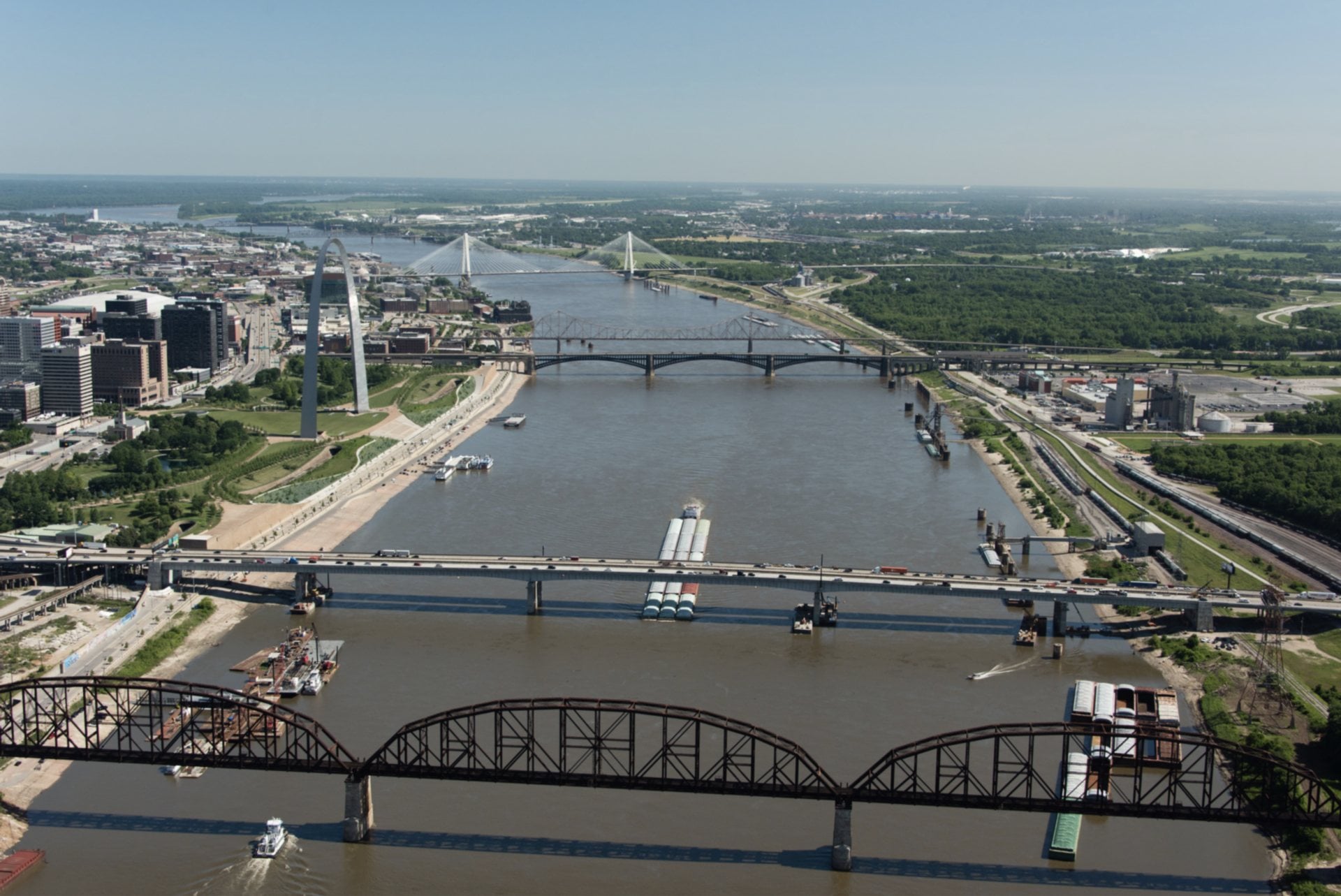
GRANITE CITY - The United States has a versatile and expansive network of navigable waterways including: rivers, bays, channels, coasts, the Great Lakes, open-ocean routes, and the Saint Lawrence Seaway System. In 2007, the Department of Transportation, Maritime Administration (MARAD), created the Marine Highway Program to help maintain and enhance "America's Marine Highway," as MARAD likes to call it.
America's Central Port (ACP) plays a critical role in leveraging the transportation opportunities that help attract the U.S. and foreign direct investment to the Southwest Illinois and Greater St. Louis region.
Get The Latest News!
Don't miss our top stories and need-to-know news everyday in your inbox.
In order to capture the full transportation potential of the Mississippi River, America’s Central Port has been pursuing container-on-barge (COB) for many years. With the completion of the Madison Harbor construction in 2016, the Port has been of the firm belief that COB can happen in the St. Louis area and that the Madison Harbor is primed for container movement
The Harbor was constructed to handle the bulk movement of grain from unit trains to barge as well as general cargoes, with the movement of containers kept in the forefront of the design of the facility. A dual access road system is one example of how the Port designed the facility with the trucking and container industry in mind. Two roads lead to the Madison Harbor general cargo dock: one bypasses a rail crossing, and the other has no overhead height restrictions. This unimpeded, redundant access reduces congestion and emissions and greatly increases efficiencies of the Harbor operator and truck/chassis drivers.
With the $1.26 million awarded from this Marine Highway grant, America's Central Port in
conjunction with their operator SCF Lewis and Clark Terminals will be able to more efficiently ship and receive containerized goods by barge (COB), providing inter-modal access to the Gulf of Mexico and cities like Chicago, New Orleans, and Memphis.
As a requirement for the Marine Highway grant, a 20.7% match of $331,200 will be shared between SCF and America's Central Port. The specific components of the project include:
? Purchase of a 275-ton crane to handle the loading of containers onto barges, as well as other commodities
? Installation of up to 18 new fixed and pan/tilt/zoom cameras at the Madison Harbor to aid in the securing of containers and notification of trucks
? Purchase of a container tilter for use in loading bulk commodities into containers
Plans are also in development regarding the laydown area for containers. While the Marine Highway grant will be used for handling equipment, on a separate project (independent of this grant application), SCF is improving the marshaling yard area in order to more efficiently handle containers as volumes grow. Given the time needed to purchase the new equipment and installation, container on barge transportation at America's Central Port is projected to be operational later this year in 2020.