
The Alton Post of the American Legion organized its sixth annual Independence Day picnic for the 1926 Fourth of July weekend. An article in the Alton Evening Telegraph on July 6, 1926 described the celebration. The event “drew the biggest crowd ever known” in Rock Spring Park, with approximately 8,000 people in attendance at the height of the festivities.
Get The Latest News!
Don't miss our top stories and need-to-know news everyday in your inbox.
One special part of the 1926 Legion event was the Sesquicentennial celebration, described as a “typical old-fashioned Fourth of July program.” It was held on the band platform and began just after 1 p.m. W.D. Armstrong, president of the Madison County Historical Society, opened the program with a short talk. Father Francis B. Kehoe gave the Invocation, Norman G. Flagg read the Declaration of Independence, and local lawyer Gilson Brown gave the formal address. “Mr. Brown was listened to attentively by a good-sized audience though it was hot and there was little shade.”
The event required months of planning: an Alton Evening Telegraph article on March 2, 1926 announced subcommittee chairmen for everything from ice cream to first aid to advertising. A June 8, 1926 article described the kind of fireworks that were going to be procured: “more aerial pieces, such as sky-rockets and aerial bombs.” All that planning was a major success. The refreshment stands sold out of food and drinks, and there were seven hundred admissions to the dance in Harry Robertson’s pavilion for afternoon and evening dances. Events for the children included a decorated vehicle parade (for both boys and girls), girls’ scarf relay race, and a boys’ stilt meet. Boys also competed in the 50-yard dash, sideward race, backward race, and forward jump.
The most popular part of the day was the fireworks display at 8:15 p.m. W.P. Boynton (of bus trip fame:https://www.riverbender.com/news/details/100-years-ago-alton-attorney-takes-first-pacific-coast-bus-trip-93406.cfm) served as traffic chairman. Boynton estimated that there were 4,000 cars in the park at the height of the festivities. Chief Rotsch of the Alton police department and his officers directed traffic, and Boynton had 50 traffic assistants, and that was apparently barely enough help. In addition to the cars actually in Rock Spring Park, hundreds were parked on the surrounding streets during the fireworks show. A traffic count on College Avenue following the fireworks display reported that “automobiles were pouring out of the park at the rate of 2,000 an hour,” so it took two hours for the line of cars to get out of the park.

Even with the fireworks over and refreshments sold out, many attendees kept the party going; it was after midnight before the park completely cleared out.
Sources
“Biggest Crowd in History at Legion Picnic.” Alton Evening Telegraph (Alton, IL), July 6, 1926.
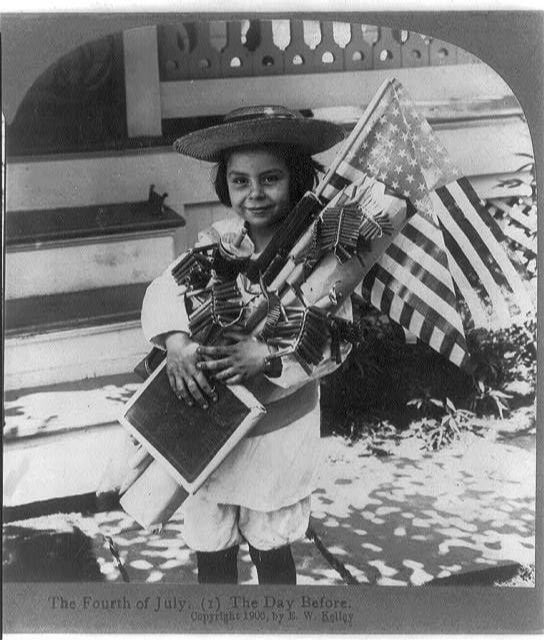
“The Fourth of July. (1) The day before.” E.W. Kelley, 1906. Library of Congress Prints and Photographs Division, LC-USZ62-47733https://www.loc.gov/pictures/item/2006690008/
“Legion Plans Annual Picnic Here, July 4.” Alton Evening Telegraph (Alton, IL), June 8, 1926.
“Holiday Plans Are Considered By Legion Post.” Alton Evening Telegraph (Alton, IL), March 2, 1926.
“Order Against Premature Use of Fireworks.” Alton Evening Telegraph (Alton, IL), June 23, 1926.
More like this: