
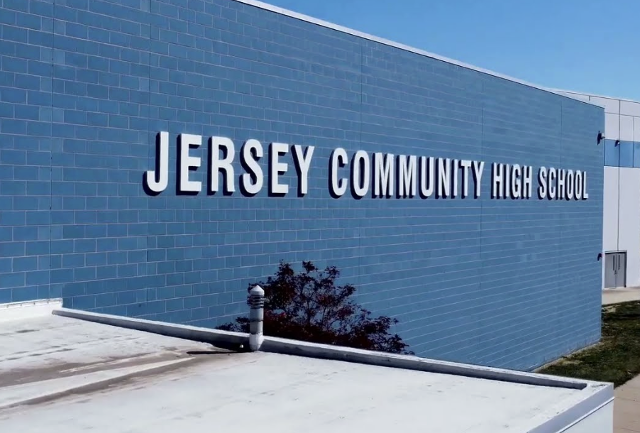
JERSEYVILLE – Members of the Jersey Community Unit School District (CUSD) 100 Board of Education voted 4-3 last Thursday, Nov. 20, 2025 to approve a tax levy increase of 7.06%.
Get The Latest News!
Don't miss our top stories and need-to-know news everyday in your inbox.
School Board members Pam Heitzig, Darcy Graham, Brad Hagen, and Peggy Perdun voted in favor of the increased levy, while Jeff Goetten, Judy Rowling, and Jacob Warford voted against it.
Ahead of last week’s School Board meeting, Jersey CUSD 100 released a “Notice of Proposed Property Tax Increase” for Jersey and Greene Counties on Oct. 20, 2025 – a potentially misleading title as a district official has since clarified the decision will not actually raise property taxes.
Jason Brunaugh, Assistant Superintendent of Finance and Human Resources with Jersey CUSD 100, said property tax costs for local property owners and taxpayers depend on the assessed value of county properties (known as the “Equalized Assessed Value,” or EAV) multiplied by the county’s property tax rates.
“If Jersey County’s EAV growth increases by the expected 7-8% or more, this tax levy would result in a decrease of the tax rate,” Brunaugh said. “Since the levy projection estimates a rate that will stay the same or go down, this levy increase will not lead to higher property taxes – however, an increased assessment would lead to someone paying a higher property tax.”
The school district’s property tax levy represents the amount of property tax dollars the school district requests – but does not necessarily receive – to operate for the following school year. By approving a tax levy increase, the district is not asking the county to raise its property tax rates, but is instead requesting a larger share of the overall property tax money already being collected.
School districts are required to set their tax levies before the county’s EAV has been calculated for the following year, and a levy cannot be increased after it has been filed. Because of this, school districts commonly establish tax levies higher than the amount they’re actually expected to receive.
If the district sets its levy lower than the county’s final EAV figures, there is no mechanism in place for the district to recover that lost revenue opportunity. But even if the district sets its levy too high, it can only legally receive the amount allowed by the county after its final EAV calculations have been made. Brunaugh said the final amount they receive may be less than the levy request, but will not be more.
In either case, one’s property tax bills would only increase if property values in the county have increased, or if the county raises its tax rate after the final EAV has been calculated. Neither scenario is directly impacted by the levy established by the school district, since their levy in an estimate made prior to the county’s final calculations.
The district received $19,288,472 in property tax funds from the county in 2024. Based on this amount, the district expects to levy up to $20,649,869 in property taxes in 2025, which would mark a 7.06% increase over the previous year. However, this estimate does not reflect the final amount the school district will actually receive from the county.
District’s Financial Health Emphasized
Brunaugh underscored the district’s effective use of taxpayer dollars while highlighting a decreased tax rate for Jersey 100 in the past nine years, amounting to a $0.53 decrease from $4.58 to $4.04. He also cited the school district’s lower-than-average amount spent per pupil.
With a statewide average of $20,000 spent per pupil, Jersey 100’s current per-pupil spending totals $13,853, which ranks them in the bottom 25% of all Illinois school districts in per-pupil expenditures, according to the Illinois State Board of Education (ISBE).
“The board has been committed to providing new opportunities and a high quality education while trying to keep the tax rate steady or declining,” Brunaugh added. “We feel very fortunate to have so many course offerings and paths for students to be college/career ready.”
At Jersey 100, lower spending per student doesn’t mean lower academic performance. Brunaugh added that the Illinois Report Card for Jersey Community High School ranks JCHS in the top 11% of all high schools statewide based on performance indicators. As of this writing, JCHS has earned a “Commendable” overall index score of 92.66 from the ISBE, which Brunaugh added is just .36% away from the designation of Exemplary.
“The investment of our school community provides advantages for the students of Jersey County and we have been witnessing special accomplishments and accolades of our students, all while limiting our per-pupil expenditures,” Brunaugh said.