Reprinted from the New York Times, January 16, 2007
AFTER a half century, Tony and Edie Vetimiglia are moving back downtown, but this time they will be living in a loft with river views and custom-made brick Roman arches instead of in an apartment above the family restaurant.
In 1954, the Vetimiglias sold their suburban home to buy a bar in this historic river town, which was said to have the best steamboat landing on the east bank of the Mississippi. They opened a restaurant called Tony's and moved upstairs with their two young sons.
Downtown Alton then bustled with commercial life, including three five-and-dimes, two jewelers, a haberdashery, a fabric shop, three locally owned department stores and two women's dress shops that could compete with the offerings in downtown St. Louis, 25 miles away. On Friday nights, when the stores stayed open late, parking spots along Third Street filled up as families sat in their cars watching the crowds stroll by.
''There wasn't anything you couldn't buy in downtown Alton,'' said Mrs. Vetimiglia, 81, who lived there for three years.
Urban blight long ago descended on Alton, as shops and factories closed. But the downtown experienced new activity in the 1970s, when dozens of antique shops opened in historic buildings, and again in the 1990s, when a casino was tied up to the riverbank, spurring more bars and restaurants. Most visitors today are day-trippers or come for the nightlife and gambling. The upstairs apartment at Tony's has been converted to a banquet room, and the restaurant has expanded into the old Young's Department Store.
Now people like the Vetimiglias are betting residential conversions will pump new life into old buildings in Alton, which is home to about 30,000 people. This spring they will move into Mississippi Landing, a 10-loft complex in the 1921 Mississippi Lime building, formerly the Illinois Terminal Railroad Building; one of their sons is buying a loft next door.
Darius Bryjka, a project designer with the Illinois Historic Preservation Agency, calls them pioneers. ''They are coming back to reclaim what they remember as the vibrancy of downtown.'' Similar developments are happening in other Illinois towns, encouraged by state and local initiatives that provide financial incentives.
''You get people living there and people will come back,'' said Duane Randall, 60, one of three partners in the Mississippi Landing project. The lofts are priced from $175,000 to $350,000 and have 12-foot-plus ceilings, exposed brick and steel beams along with river views.
Mr. Randall and his wife, Nancy, whose families have been in Alton for over 100 years, already live downtown, having traded their home upriver at the local country club for a loft penthouse at the 1846 Laura Building, which housed a pool hall most of the last century.
Penelope Schmidt, 49, a second partner, who sold her Manhattan art gallery after Sept. 11, 2001, to return to the area where she grew up, will live at Mississippi Landing. The third partner, Daniel Warren, helped jump-start loft development in 2001 when he began renovating the Laura Building, which now has four loft-style condominiums as well as a children's shop run by his wife and her sister.
The partnership is already negotiating for other downtown properties, but the city has enough lofts to warrant last fall's sold-out loft tour, sponsored by the Alton Marketplace Association, a not-for-profit organization formed to revitalize the river city. ''We hoped that by having such an event, we can stir up interest in the economic development of our downtown,'' said Nancy Elson of the Loft Tour Committee.
An easy commute to St. Louis across a dramatic modern bridge, Alton has long been considered an ideal satellite city, more convenient than some of the western St. Louis suburbs, but much of the residential activity is being fueled by local residents, who like the idea of walking instead of driving everywhere. Mississippi Landing has had inquiries from as far away as Florida, though mostly from people wanting to come home again.
Rob Hellrung, 63, who commuted 45 minutes for 10-hour shifts at the St. Louis Ford plant for 30 years, considered buying a loft in St. Louis when he retired, but he considered it to be too gritty. Instead, he moved from his cedar-sided home with a workshop in an Alton suburb to a Laura Building loft where he can watch the barges go by from his balcony or his bed.
''I had always looked for this kind of structure, a loft structure,'' he said. ''I liked what I saw in the movies and in the magazines.''
Besides, he can walk everywhere -- to the library, restaurants, bars -- cutting his fuel consumption by two-thirds.
Judy Hoffman, 65, an Alton historian, is selling her home to move into Mississippi Landing because she's tired of yard work and steps. She's looking for an adventure downtown. ''This is as urban as you're going to get in this area,'' she said.
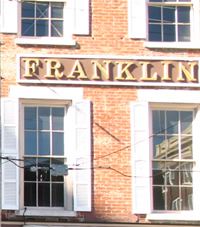
It's not only the condo market moving into downtown. Julie Harper, a local lawyer, and her husband, Jason, a stockbroker, rescued a mid-19th-century Georgian home, renovating it into their offices and two rental apartments four years ago. Now they're tackling the decrepit Franklin House, where Abraham Lincoln is said to have stayed when he debated Stephen A. Douglas in the 1858 Senate race. Life-sized bronze statues mark the debate spot in a park opposite the Argosy Casino.
''The pigeons deterred other buyers,'' Mrs. Harper said, even as she shooed away birds on third-floor rafters. The Harpers plan to convert the structure into Lincoln Lofts, about a dozen rental units on the top three floors with commercial space at street level. ''There's nothing like this in Alton; it's a niche that needs filling,'' she said.
Mike Kelly, 44, a former Marine pilot, lives on the top floor of an 1866 cracker factory with three of the original five oven vaults still evident in the basement. At least three antique dealers have lived on the property, including Sam Thames, who was credited with creating the Alton Antique District. Mr. Kelly has moved into Mr. Thames's old space, which includes a raised stage where either a church or a fraternal society held services. He plans to develop the building commercially.
Most real estate incentives have been for commercial development, but the city says it supports downtown residential development as well. Philip S. Roggio, director of the Department of Development and Housing, says the city's future lies in the ''marrying of public and